Heart
These proportions are closest to a heart face. Everything below is derived from the measurements, not from that word.
This report at a glance
Three conclusions from these numbers
Face shape
Heart, led by a length:width of 1.38:1 and a 134° jaw angle.
Hair direction
Keep the crown flat and add width at the sides, with length past the chin and layered or blunt ends.
Frames
Frames to try: Oval, Round, Aviator.
Most numbers below carry a chip like this. Hover, focus, or tap it for how far a retake would move that number.
Do this first
At the barber or hairdresser
Take the length past your chin.
Your lower third is 0.99×, against a mid-range of 1.02-1.10×. Of your four shape numbers, it sits furthest outside its own mid-range, so it is the one a cut or a frame most needs to account for.
from your lower third, 0.99× · mid-range 1.02-1.10×
Sample visual look brief
3 hairstyle directions, generated once for this sample
AI styling concept on an AI-generated face, not a real person and not a forecast. On a real report, the buyer chooses their own photo and these three directions are generated after payment.
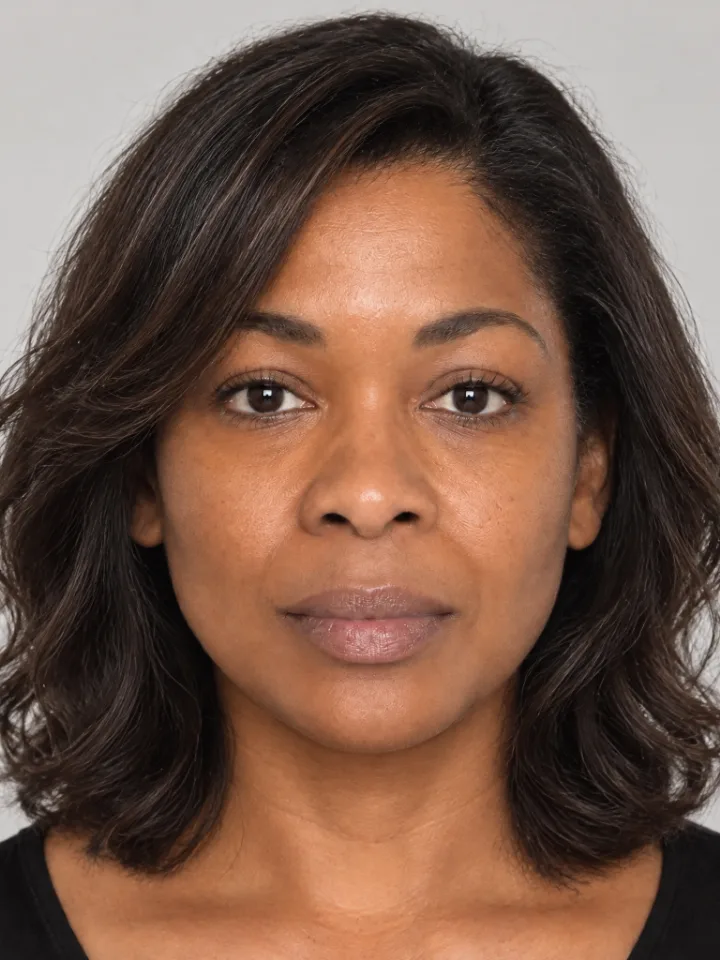
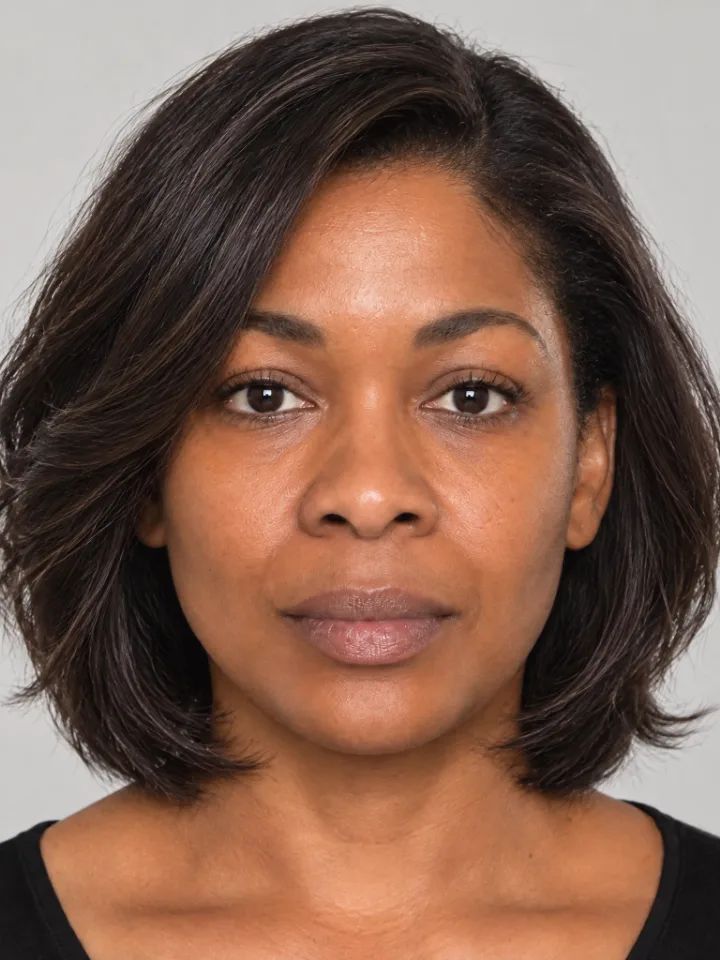
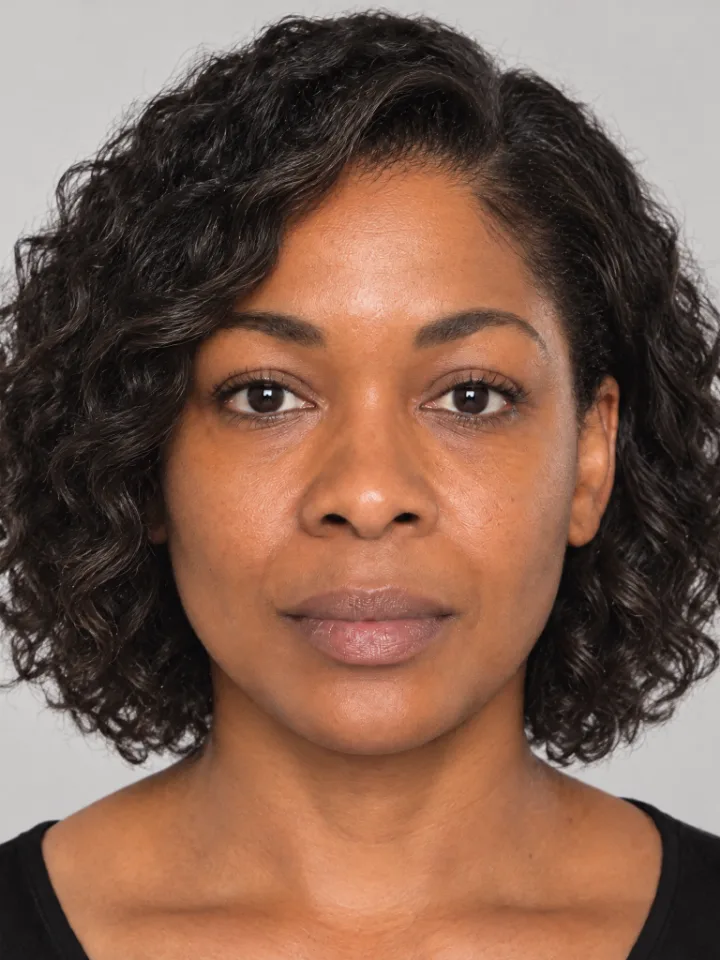
Your stylist & optician brief
Open this page on your phone, read one out, or paste it into a message to the person about to cut your hair or help you choose frames. Every recommendation is tied to measurements shown in the report below.
At the barber or hairdresser
My face measures 1.38 to 1, length against cheekbone width, so keep the crown flat and add width at the sides. Please take the length past my chin, and layered or blunt at the jaw, either will sit right. My jaw angle is 134 degrees.
from Length to width 1.38 : 1 · Lower third 0.99× · Jaw angle 134°
At the optician
I am looking for deeper lenses, to shorten the face, with most bridge styles, and round or angular rims. My face is 1.38 to 1 and the gap between my eyes is 1.21 times one eye width. My eye corners sit in the neutral range, 0 to 5 degrees, so a straight or softly lifted top works.
from Length to width 1.38 : 1 · Eye gap to eye width 1.21× · Jaw angle 134°
Your proportions, and the shape they add up to
Four numbers decide your face shape, so you can see which one is doing the work. Each shows how much it would move if you took the photo again. Face length includes an estimated +12% for the hairline, which the camera model can't see.
- Length : width
- 1.38 : 1face length against cheekbone width
- The single largest influence on the label. Above about 1.5 reads long, below about 1.35 reads wide.
- Forehead : cheekbone
- 0.87measured at the temples, not the hairline
- Measured at the temples because the mesh has no hairline point, so hair over the temples narrows this number.
- Jaw : cheekbone
- 0.78jaw width against cheekbone width
- Separates square and round from heart and diamond.
- Jaw angle
- 134°angle at the corner of the jaw
- A smile or a beard moves the points this is taken from, so a relaxed closed-mouth photo gives a steadier number.
Hair, and the measurement behind each suggestion
Keep the crown flat and add width at the sides, with length past the chin and layered or blunt ends. Each line shows the number behind it. Bring this to your next appointment.
- Length : width
- 1.38 : 11.28-1.36
- Longer face → flat crown, width at the sides.
- Lower ÷ middle third
- 0.99×1.02-1.10
- Shorter lower third → length past the chin.
- Jaw angle
- 134°132.7-135.7°
- Mid-range → layered or blunt ends both work.
Glasses, and the measurement behind each suggestion
Frame shapes that suit these proportions: Oval, Round, Aviator. Take this to an optician rather than treating it as a purchase list; a frame that measures right can still sit wrong on a face.
- Length : width
- 1.38 : 11.28-1.36
- Longer face → deeper lenses shorten it.
- Eye gap ÷ eye width
- 1.21×1.16-1.23
- Mid-range → most bridges fit.
- Canthal tilt (R / L)
- +4.1° / +4.0°0° to 5° neutral · floor ±1.6°
- Neutral range (0° to 5°) → straight or softly lifted tops.
- Jaw angle
- 134°132.7-135.7°
- Mid-range → round or angular rims both work.
The eight classical ratios, measured
These are the ratios the golden ratio canon is built from. The canon is an aesthetic convention from the Renaissance, not a finding about faces, so a gap here is a distance from a convention and not a defect.
- Face length to face width
- 1.38classical target 1.618
- −14.9% from the classical target.
- Mouth width to nose width
- 1.56classical target 1.618
- −3.7% from the classical target.
- Chin to lips, against lips to nose
- 1.61classical target 2.000
- −19.5% from the classical target.
- Lower third to middle third
- 0.99classical target 1.000
- −0.7% from the classical target.
- Upper third to middle third
- 0.50a typical face reads 0.56 here (classical target 1.000)
- −12.3% from a typical reading. This tool reads every face about 44% under the classical target on this ratio, so that gap is the measurement, not your face.
- Face width in eye widths
- 4.73classical target 5.000
- −5.3% from the classical target.
- Eye gap to eye width
- 1.21a typical face reads 1.21 here (classical target 1.000)
- +0.3% from a typical reading. This tool reads every face about 21% over the classical target on this ratio, so that gap is the measurement, not your face.
- Nose width to eye gap
- 1.03classical target 1.000
- +2.5% from the classical target.
- Average gap across all eight
- 14.8%higher than 70% of our 43 reference faces
- The upper third and eye gap rows above lift every face's average, yours included, so compare this with the reference faces (measured the same way), not with zero.
Left against right
Sixteen mirrored point pairs, compared across the facial midline. Every face is asymmetric; the question this answers is whether yours is asymmetric by more than this photo can resolve.
- Symmetry offset
- withheldBelow this photo's own measurement floor of 0.57% of face width, so there is nothing here that can be told apart from the detector moving between passes.
- Measured as a fraction of face width, so it does not change with how close you stood to the camera.
Eye angle and eye opening
The two eyes are kept apart rather than averaged, because the average is what hides a difference between them.
- Canthal tilt, right eye
- +4.1°inner corner to outer corner, head rotation undone first
- Positive means the outer corner sits higher than the inner corner.
- Canthal tilt, left eye
- +4.0°inner corner to outer corner, head rotation undone first
- Reported on its own. Your two eyes routinely differ, and that difference is real information.
- Eye opening
- 0.34 h:wmore open than 47% of our 43 reference faces, give or take (37% to 72% on a retake)
- Height of the eye opening divided by its width. This is the opening, not the eyelid crease.
What this report will not tell you
Included because a report that quietly omits its limits reads more authoritative than it has earned.
Almond, hooded, monolid and deep-set are all defined by a fold or a depth, and a fold is not visible from the front. A shadow, a low camera angle or eyeliner along the lash line all reproduce one that is not there. So the eye section gives you the opening ratio and where it sits, and stops.
The landmark model has no hairline point, so forehead width is taken at the temples. We generated 21 portraits with explicit diamond geometry and the hair pulled back: not one of them classified as diamond. The tool finds diamond when hair hides the temples and misses it when the forehead is visible, which is close to the opposite of what it should do.
There is no attractiveness number here and there will not be one. The measurements describe proportions; they do not rank people, and the research usually cited to suggest otherwise reports small average differences across groups rather than a threshold an individual face passes.
It has never been checked against professionally labelled photographs, because no such dataset exists for this taxonomy that we could use. What we can tell you is that it is stable: the same face measured repeatedly lands on the same label, and a face near a boundary is shown as two shapes rather than forced into one.
- For styling and curiosity. This is not medical, dental or cosmetic advice, and nothing here should be used to decide on a procedure.
- Face length includes an estimated +12% for the hairline, which the landmark model cannot see.
- Percentiles place you against 43 AI generated reference faces, not photographs of people. They describe what an image generator produces and how precisely this tool measures it.
- Your photo was measured in your browser. Nothing derived from your face left your device for this report: no image, no landmark points, no geometry. Only the numbers printed above were sent, and they are deleted the moment you ask. A photo reached Kie.ai only if you ticked a box for a try-on.