Ghana, N=202
Akan and Ewe adults aged 18-27, Kumasi, digital calipers, each measurement repeated
Akan men 95.5, Akan women 91.3, Ewe men 96.6, Ewe women 84.1
This nose shape tool measures four things from a straight-on photo in your browser, starting with the nasal index. Then it tells you which of the familiar nose shape names a front photo can actually judge, and which ones need a profile and so cannot be established from the front at all.
Front-facing photo, even light, hair off the forehead
Your own four measurements replace this diagram once a photo is measured.
Here is the whole popular list of nose shape names, with the part nobody usually says out loud attached to each entry: whether the thing each nose shape describes is even visible from the front. Three of the nine are measurable straight on. Two are hinted at. The remaining four are bridge and tip features that live in profile, which is why a front-photo tool that confidently hands you Greek or Roman is guessing.
Wings set wide relative to the height of the nose. This is the platyrrhine end of the nasal index.
A front photo can measure this
Wings set close relative to the height of the nose. The leptorrhine end of the same index.
A front photo can measure this
The bridge does not run straight from its top to the tip.
A front photo can measure this
A tip that reads as rounded and wide relative to the bridge above it.
A front photo hints at this
A short nose with a rounded tip. Height shows from the front; the roundness does not.
A front photo hints at this
A bridge that runs straight from the brow to the tip, judged in profile.
Needs a side photo
A bridge with a raised hump partway down, judged in profile.
Needs a side photo
A strongly convex bridge with a downward-pointing tip, judged in profile.
Needs a side photo
A tip rotated upward, which is a rotation you can only see from the side.
Needs a side photo
Worth knowing where the list comes from. Most of these names are popular classification with roots in nineteenth-century physiognomy, which attached character traits to nose shapes and had no business doing so. They survive because they are vivid, not because they are precise. The nasal index below is the one measurement here with a real anthropometric literature behind it.
The nasal index is the one nose shape measurement with a real literature behind it: nose width over nose height, times 100. Anthropometry sorts it into five descriptive bands. The strip below puts those bands, our own measured range and one published population study on the same axis, so you can see how much of the scale real faces actually occupy.
Population figures from Soumboundou, Ndiaye, Nouaman, Farhat and Lecor, "Three-dimensional anthropometric study of the facial morphology of black African Senegalese: 3D photogrammetric approach", Journal of Oral Biology and Craniofacial Research, 2023, which also sets out the five bands used here. Their measurements were taken on 3D scans, ours from landmarks on a flat photo, so the two are comparable in scale but not method.
Nasal proportions differ between populations, and the literature reports that as ordinary descriptive variation. Different groups sit in different parts of the range. That is the reason no nose shape band here is described as better, and the reason an average from any single study is not a target for anyone. Ranges describe groups. They do not grade individuals.
| Measurement | Median | Smallest | Largest |
|---|---|---|---|
| Nasal index | 78.38 | 62.24 | 93.87 |
| Wing flare | 1.13 | 1.07 | 1.15 |
| Bridge straightness | 0.28 | 0.16 | 1.28 |
| Tip projection (weak) | 0.52 | 0.45 | 0.57 |
| Nose length share | 0.37 | 0.32 | 0.39 |
Read the tip projection row against the nasal index row and you have the argument for why this nose shape tool marks that measurement weak. The nasal index spans 62.2 to 93.9 across these faces, a real spread. Tip projection moves from 0.45 to 0.57 across the same faces, which is barely movement at all. A measurement that returns nearly the same answer for everybody is not measuring the thing it is named after. It is reported here because leaving it out silently would be worse than showing it with the caveat attached.
The index bands came out 27 mesorrhine, 5 leptorrhine, 11 platyrrhine. And a small implementation detail worth publishing: of the three candidate wing pairs in the nose contour, the pair 64 and 294 was the widest on 41 of 43 faces, which is why the code takes the widest rather than trusting any one pair.
Measured 2026-09-16 by running this same tool over every AI generated face in our set. Synthetic faces throughout, so these describe the generator and this tool, never a population.
Roman, Greek, hawk, snub, celestial. That nose shape list is not a summary of anatomy and it is not old folk wisdom. It is the six-class scheme from a single book, Notes on Noses, published in London in 1848, and the book assigns a personality to each class. This is the sentence under Class II, the one that produced every "Greek nose meaning" search you have ever seen:
"It indicates Refinement of character, Love for the fine arts and belles-lettres, Astuteness, Craft, and a preference for indirect, rather than direct action."
Class I, the Roman or aquiline, "indicates great decision, considerable Energy, Firmness, Absence of Refinement." The author is in earnest about it, writing that "Nasology is strictly in harmony with the deductions of the ablest physiognomists and ethnologists," and he hangs the whole scheme on the racial hierarchy of his day, arguing that a "flat, depressed Nose" indicates "a similar mind" to what he claims protruding jaws indicate. One of his six classes is explicitly antisemitic.
You will sometimes read that the book was a parody of phrenology. We could not verify that against any primary source, and the preface and first chapter read as sincere advocacy, so we are not going to repeat it as fact. What is certain either way is how it was received and reused: as serious character reading. And it is still in circulation, because it is the taxonomy on the nose pages currently ranking for these searches.
Clinic listicles draw a crisp distinction between a Roman nose and an aquiline one. The two foundational sources use the words in incompatible ways. The 1848 scheme makes them the same thing, Class I, "The Roman, or Aquiline Nose," and puts the strongly hooked nose in a separate class. Topinard's 1885 anthropology does the reverse: aquilin is the whole convex family, with the hooked nose, crochu, as one variety inside it. Any page giving you a confident Roman-versus-aquiline distinction is inventing it, because the sources it would have to rest on disagree.
Topinard also recorded that travellers applied the labels to whoever was in front of them, describing aquiline and Roman noses among Ashanti, Australian and Papuan people, and concluded dryly that one can understand how a traveller might be mistaken.
Two primary sources settle this, and no competitor page carries either. Winckelmann's 1764 history of ancient art, the source of the idea, introduces it as a term of art: "the Greek profile, as it is called, is the first and principal attribute of a high style of beauty," describing "a nearly straight or slightly-depressed line which the forehead and nose describe in youthful heads."
A century later the anthropologist who did more than anyone to measure noses looked for it in living people and did not find it. Topinard, 1885, writing about the perfectly straight profile: one cannot explain the idea the Greek artists had in choosing this line of convention, "which is met with today neither in Greece nor in Italy." He adds that the exactly straight nose is rare in any case, since there is always some slight inflexion at both ends of the lateral cartilages.
So the most sought-after nose shape on the internet is a drawing convention, named after a place where the person who went looking for it reported it does not occur. That is the honest answer to "what is a Greek nose," and it is more useful than a diagram.
The measurement at the centre of this nose shape page has a history, and burying it in a footnote would be dishonest. The nasal index was created by Paul Broca in the nineteenth century and used by its own authors to sort human populations. Topinard, writing in 1878, put it this way, and the sentence gives the whole enterprise away:
"M. Broca has, in fact, discovered that the nasal index is one of the best for the purpose of distinguishing the various races of mankind, although he does not arrange them in a regular scale conformably to the exalted idea that we ourselves form of those races."
Read that again: the complaint is that the measurements refused to sort people into the order the authors wanted. That is what a hierarchy-building project looks like when its own instrument will not cooperate. It is the reason nothing in this nose shape tool ranks a band, sorts a table by value or puts an "ideal" column beside a population figure.
This trips up nearly every page that quotes the index. Broca's original boundaries were about 42 to 47 for leptorrhine, 48 to 52 for mesorrhine and 53 upward for platyrrhine. Those are skull measurements, taken on bone. The index measured on a living face is a different quantity on a different scale: Topinard's own sample of 78 Europeans averaged 68.1 on the living-subject version, which would be off the top of the skull scale entirely.
The modern living-subject boundaries this nose shape tool uses, under 70, 70 to 85, and above 85, are worth being straight about too. We traced them through three papers that state them, and each cites another study rather than a primary methodological source. None of the chains we followed reaches Broca, Topinard or Martin. They are inherited numbers in wide use, not derived ones, and we use them because they are the shared vocabulary, not because we found their derivation.
Even in the nineteenth century the same Greek-derived words meant different numbers in different national schools, which Topinard warned about directly: one should be wary when the German writers speak of mesorrhiny, because it may be what he would call platyrrhiny.
These nose shape figures are not ranked, not sorted by value and not compared to any ideal. Each is a separate description of a separate group of people, with the method and the sample attached, which is the only way figures like these can honestly be shown.
Akan and Ewe adults aged 18-27, Kumasi, digital calipers, each measurement repeated
Akan men 95.5, Akan women 91.3, Ewe men 96.6, Ewe women 84.1
Medical students aged 16-25, Dhanusha, vernier caliper
Mesorrhine in 60.5% of the sample
Adults aged 18-70, Ilorin, sliding caliper
Men 90.7, women 88.2; platyrrhine most common at 70.5%
Lingayat adults, Mysuru, digital caliper
Men 71.3, women 71.1; leptorrhine most common in both
The Ghanaian authors make the point we would: it "is inappropriate to apply nasal dimensions of one ethnic group to another," since geography and nutrition influence nasal morphology. Different groups occupy different parts of the range. That is all this says. It is variation, the same way height is variation, and no part of the range is a target.
Surgical planning uses two nose shape angles this tool cannot measure, because both are side-view quantities. They are worth explaining anyway, because the "normal ranges" attached to them are shakier than they look.
The nasofrontal angle, where the nose meets the brow, has at least three incompatible definitions in circulation, two of which do not even share a vertex and therefore cannot produce the same number on the same face. Measured values across four studies run from about 110 degrees in a clinical Indian sample to about 146 in a Syrian one, and some of that spread is real variation while some of it is simply people measuring different angles. The familiar "115 to 130 degrees normal" comes from a 1984 monograph as a proposed target, and no paper we read states a sample size, a population or a protocol behind it. A 100-person Brazilian study that set out to test it measured 137.1 on average, outside the range entirely.
The nasolabial angle, between the base of the nose and the upper lip, comes with a textbook sex difference: about 90 to 95 degrees for men and 100 to 110 for women. Three measured samples do not reproduce it. In 165 Lebanese adults the sexes differed by 0.12 degrees. In 100 Brazilians the difference was not significant and ran backwards, men higher than women. In 100 Syrians the two values were 102.18 and 102.03. Published norms across studies span roughly thirty degrees with the male and female direction flipping between them.
This is also the clean geometric reason the tool above measures what it measures. In a published measurement protocol the frontal view yields two of six nose measures, and both are widths. Every angle and every projection ratio is a lateral-view quantity, because they are displacements along the axis that a straight-on photograph flattens to nothing. A front photo cannot see them. Ours does not claim to.
Sources: Eden Warwick [George Jabet], Notes on Noses, London 1848/1864 · Winckelmann, The History of Ancient Art Among the Greeks, 1764, English translation 1850 · Topinard, Anthropology, English translation 1878, and Elements d'anthropologie generale, Paris 1885 · Robertson et al. 2024 (Ghana, N=202) · Jha et al. 2023 (Nepal, N=215) · Jimoh et al. 2011 (Nigeria, N=105) · J Oral Maxillofac Pathol 2025 (South India, N=305) · Ballin et al. 2018 (Brazil, N=100) · Saadeh et al. 2025 (Lebanon, N=165) · Torbey et al. 2024 (Syria, N=100).
Every card below is an AI generated face put through the same code the nose shape tool at the top of this page runs, showing the numbers as they came out. Sort them by index or filter to one band to see how little the type names would tell you that the measurements do not.
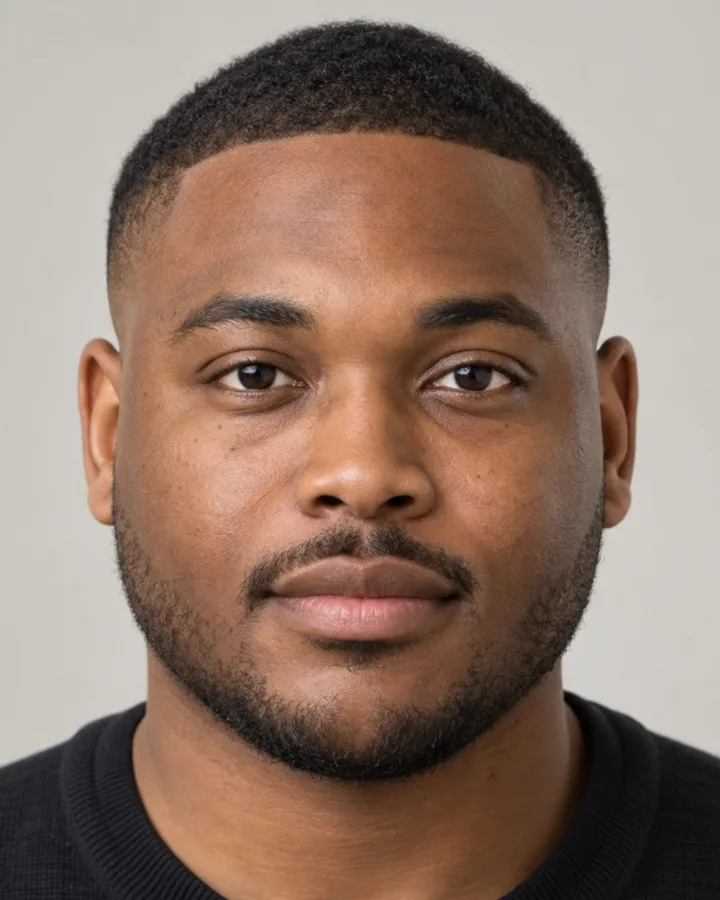
87.4
Platyrrhine
Bridge off straight by 0.4%
flare 1.14× · length 35% · wings 64/294
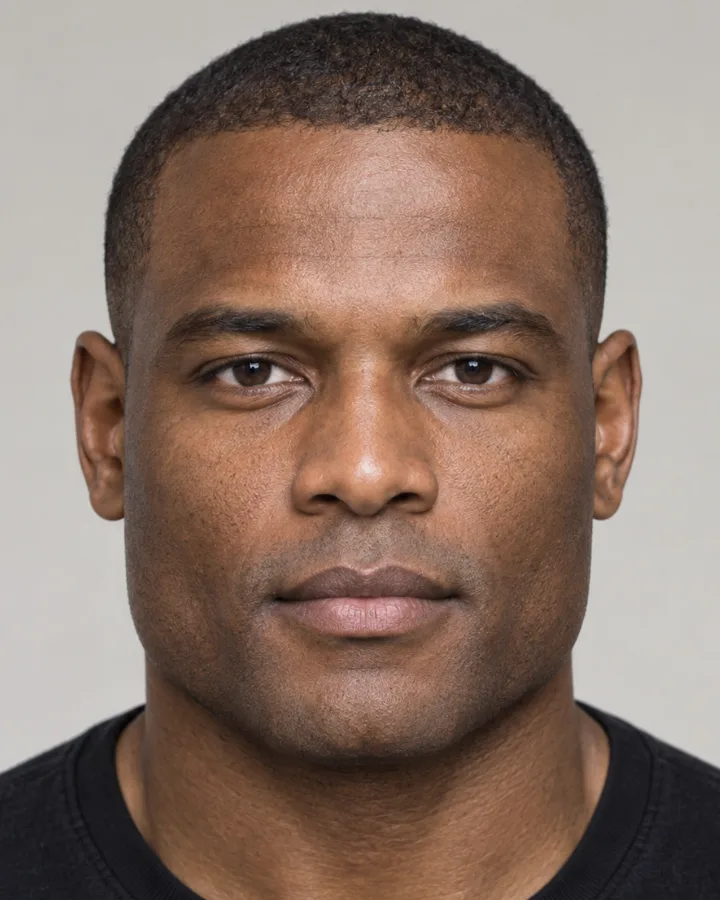
87.2
Platyrrhine
Bridge off straight by 0.4%
flare 1.14× · length 34% · wings 64/294
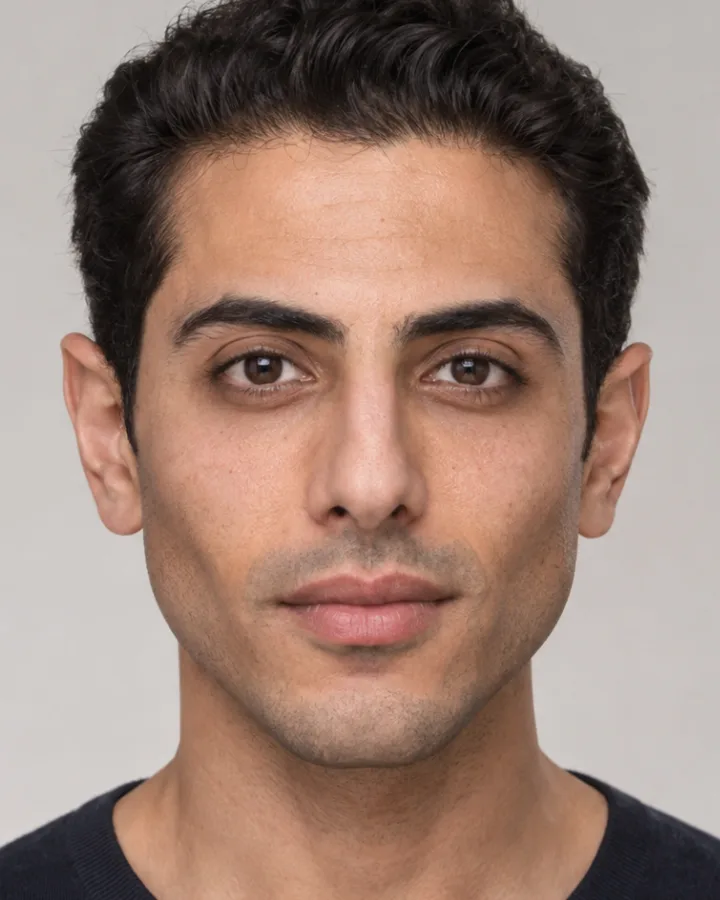
79.8
Mesorrhine
Bridge off straight by 0.4%
flare 1.14× · length 35% · wings 64/294

77.8
Mesorrhine
Bridge off straight by 0.5%
flare 1.15× · length 33% · wings 48/278

77.5
Mesorrhine
Bridge off straight by 0.5%
flare 1.14× · length 36% · wings 64/294
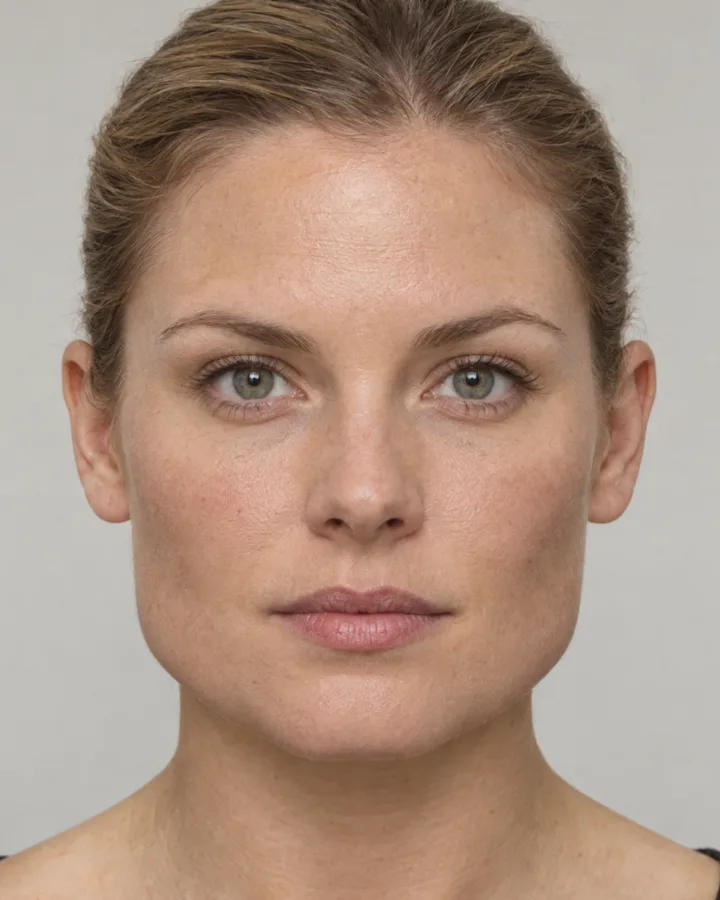
76.2
Mesorrhine
Bridge off straight by 0.6%
flare 1.14× · length 36% · wings 64/294
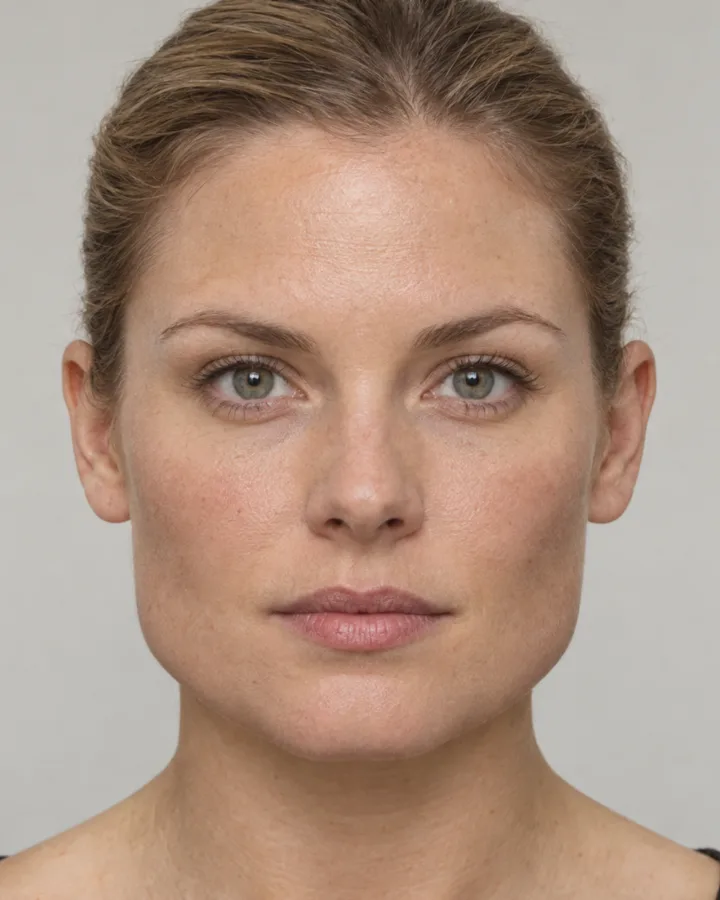
76.2
Mesorrhine
Bridge off straight by 0.6%
flare 1.14× · length 36% · wings 64/294
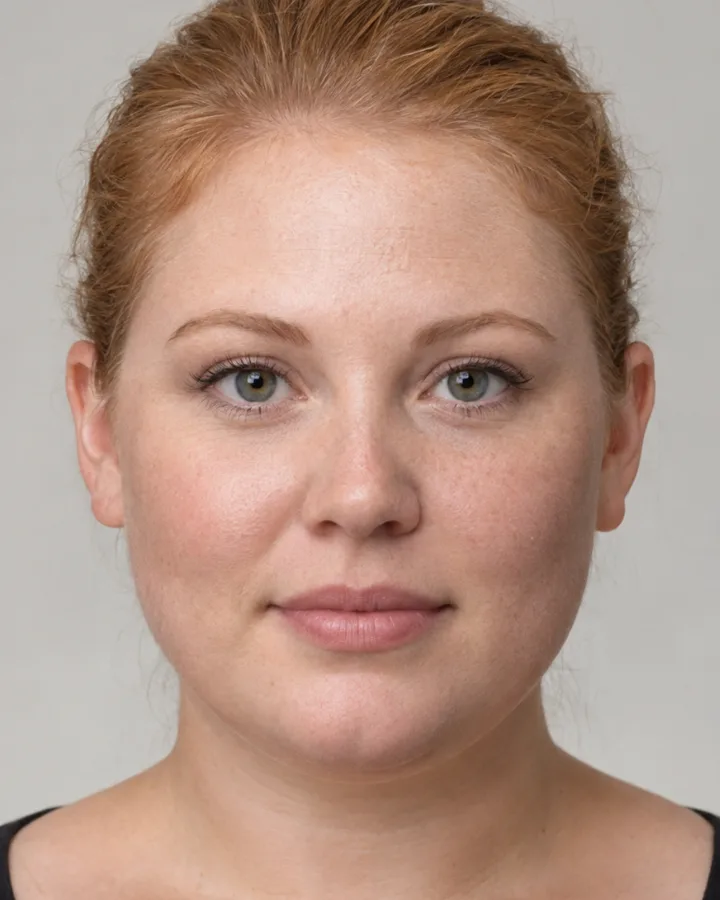
73.0
Mesorrhine
Bridge off straight by 0.4%
flare 1.13× · length 38% · wings 64/294
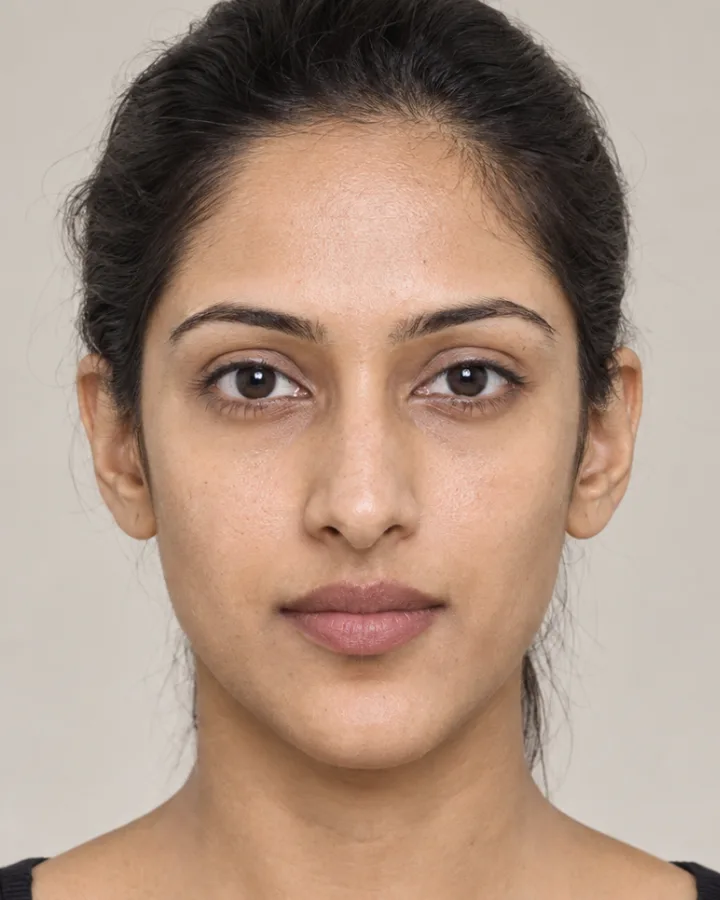
68.9
Leptorrhine
Bridge off straight by 0.5%
flare 1.13× · length 38% · wings 48/278
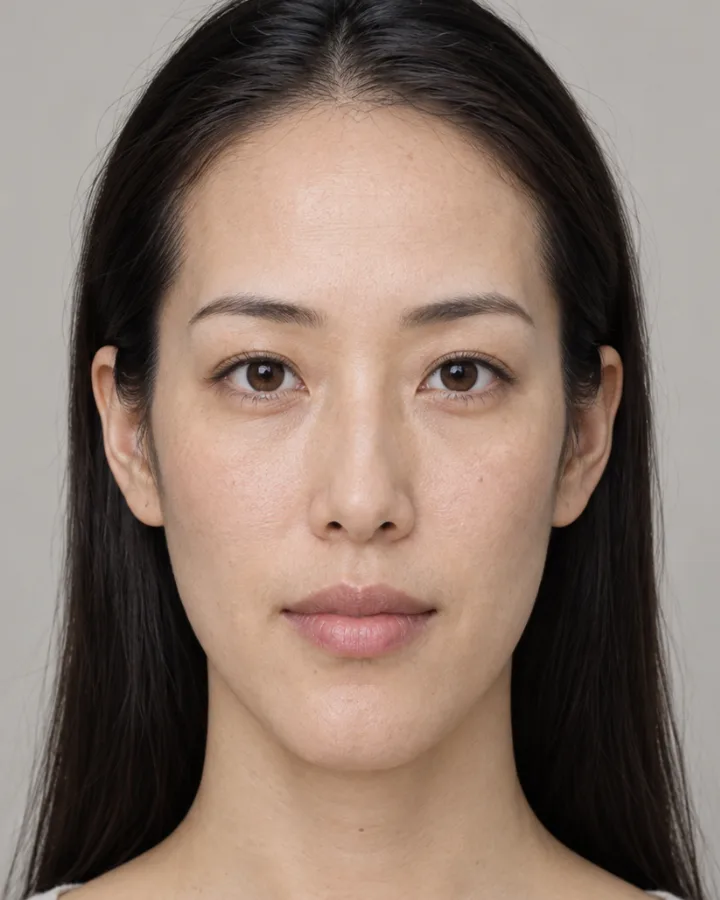
67.8
Leptorrhine
Bridge off straight by 0.4%
flare 1.13× · length 35% · wings 64/294

67.7
Leptorrhine
Bridge off straight by 0.5%
flare 1.13× · length 37% · wings 64/294
Start with the measurement rather than the label, because the labels are looser than they look. This nose shape tool measures four things from a straight-on photo: your nasal index, which is the width across your nose wings divided by its height from the top of the bridge to the base; how far the wings flare past the nostril edges; how straight the bridge runs; and, weakly, how far the tip projects. The nasal index is the one with a real anthropometric history behind it and real published numbers to compare against. Names like Greek or Roman describe the bridge seen from the side, which no front photo can show, so this nose shape page tells you which names are even in play.
The commonly listed types are straight or Greek, Roman or aquiline, hawk, snub or button, turned-up, wide, narrow and crooked. It is worth knowing where that list comes from: most of it is popular classification that grew out of nineteenth-century physiognomy, which assigned character traits to nose shapes and was wrong to do so. Anthropometry uses something narrower and better defined, the nasal index, which sorts noses by width against height into five descriptive bands. Our own measurements make the point directly. Of the popular type names, only three describe something a front photo can measure at all; the rest are profile features.
The nasal index is nasal width divided by nasal height, multiplied by 100. In anthropometry the width is taken between the alare, the most lateral point of each nose wing, and the height from the nasion at the top of the bridge down to the subnasale where the nose meets the lip. This page does the same arithmetic on landmark points instead of calipers. It reads MediaPipe's nose contour, takes the widest available wing pair as the alare, and measures down to the point where the nose meets the lip. The classes are descriptive width bands, not a scale anyone should be trying to move along.
Anything about the bridge profile, which is most of what the popular type names describe. A Roman or aquiline nose is defined by a hump in the bridge seen from the side. A Greek or straight nose is defined by the absence of one. Turned-up and hawk describe the rotation of the tip, up or down, which is again a profile feature. How far the tip projects forward is also a depth measurement. This page does estimate that one from the mesh's inferred depth, but it marks it weak wherever it is shown, and our own numbers show why: across every face we measured the value barely moved.
Yes, and the anthropometric literature reports it plainly as descriptive variation. One 3D photogrammetric study of 104 Senegalese adults aged 16 to 45 reported a nasal index of 82 percent for men and 76.8 percent for women, both inside the mesorrhine band. Different populations sit in different parts of the range, which is why a single average is not a target and why nothing in this nose shape tool treats one band as better than another. It is also why comparing your own number against one study's average tells you very little on its own. Ranges describe groups; they do not grade individuals.
It gives you a number for it, with an honest caveat attached. The bridge straightness measurement takes the chain of landmark points that runs down your bridge and finds the furthest any of them strays sideways from a straight line between the top of the bridge and the tip, then reports that as a share of your nose width. On the faces we measured the median came out at a fraction of a percent, with the largest a little over one percent, so the measurement does separate straighter bridges from less straight ones. But a head turned even slightly toward the camera produces exactly the same signal, so square up to the lens before you read anything into it.