Negative tilt
below 0°
The outer corner sits lower than the inner corner.
This canthal tilt test measures the angle from your inner eye corner to your outer eye corner, in degrees, for each eye on its own. It undoes head tilt first, and it tells you how precisely it could measure before it gives you a number.
Front-facing photo, even light, hair off the forehead
Your own two angles replace this diagram once a photo is measured.
Canthal tilt is the angle between the line joining your two eye corners and horizontal. The inner corner, next to the nose, is the medial canthus; the outer corner is the lateral canthus. When the outer corner sits higher than the inner one the tilt is called positive, when it sits lower it is called negative, and when the two are close to level it is usually called neutral. It is a description of one angle on one face, nothing more. This canthal tilt test measures that angle on each eye on its own, in degrees, after undoing any head tilt in the photo, and it tells you how precisely it could measure before it tells you the number.
The page puts 478 points on your face inside your browser, then takes four of them: the two corners of each eye. In MediaPipe's own eye contours those are points 33 and 133 for your right eye and 263 and 362 for your left. Head rotation is undone first using the model's pose matrix, otherwise a head tilted a few degrees would add its own tilt to both eyes. Then for each eye it takes the vertical gap between the two corners, divides by the horizontal distance between them, and converts that to an angle. A positive result means the outer corner came out higher. Both eyes are reported separately rather than averaged.
This page does not rank eye angles and will not tell you a higher number is better. Canthal tilt is one measurement among many, and the research people usually cite on eye angle and attraction reports small average effects across groups rather than a threshold an individual face passes or fails. What our own measurements can tell you is how narrow the real spread is. Across the AI generated faces we measured, every eye landed between about half a degree and nine degrees positive. Those are synthetic, so treat that as a property of the image generator rather than of people; the published human figures we cite alongside sit higher. What the spread does show is that a degree or two is a few millimetres of height on a real head, too small to see reliably in a mirror, and not a defect.
The boundaries this page uses are the ones published by Lee, Choung and Choung in 2020 in the Journal of the Korean Association of Oral and Maxillofacial Surgeons: Class I from zero to five degrees, Class II above five, Class III below zero. That paper measured 76 Korean patients aged 13 to 38 who were being assessed for surgery, using standardised frontal photographs. So those are one paper's boundaries drawn on one clinical group, not a worldwide norm, and there is no agreed cutoff that everyone uses. We show the bands because a number with no scale beside it is hard to read, not because crossing one of them means anything about you.
Almost everyone's do, a little. The more useful question is whether the difference is bigger than the measurement noise, and this page answers that explicitly. Every photo is measured five times with tiny shifts and the landmark points move slightly between passes, which sets a floor in degrees below which a difference cannot be trusted. Here is the honest result from our own set: across all the faces we measured, the gap between the two eyes was never once larger than that floor. The median gap was under one degree. So unless your two eyes come out several degrees apart, treat the difference as unproven rather than real.
Easily, and this is the main reason to take the number loosely. A head tilted toward one shoulder rotates both eye lines together, which this page corrects using the pose matrix, but a head turned to one side also foreshortens one eye more than the other and that cannot be undone from a single image. Looking above or below the lens changes where the lid edges sit. Squinting into bright light pulls the outer corner. Heavy eye makeup along the lash line moves the point the model picks for a corner. Take the photo square to the camera, at eye level, with a relaxed face and even light.
The three names describe where the outer corner sits relative to the inner one. The numeric boundaries below are the ones used by Lee, Choung and Choung (2020) in the Journal of the Korean Association of Oral and Maxillofacial Surgeons, who measured 76 Korean patients aged 13 to 38 from standardised frontal photographs while assessing them for surgery. That is a clinical group in one country, so treat the boundaries as that paper's convention rather than a norm.
below 0°
The outer corner sits lower than the inner corner.
0° to 5°
The outer corner sits level with, or a little above, the inner corner.
above 5°
The outer corner sits clearly above the inner corner.
Their cohort averaged 8.45° on the right eye and 8.42° on the left, with standard deviations of about 3.5 and 3.8 degrees. Our own faces came out lower, at a median of 4.9°. Two different pipelines on two different sets of faces should not be expected to agree: theirs were clinical photographs of patients under assessment, measured against a line perpendicular to the facial midline, and ours are AI generated images measured from landmarks after a pose correction. The comparison is useful for scale, not for deciding whose number is right.
Four landmark points do all the work. MediaPipe's eye contours put your right eye's corners at indices 33 and 133 and your left eye's at 263 and 362; the angle for each eye is the vertical gap between its two corners over the horizontal distance between them. Head rotation is undone before any of that, using the pose matrix the model returns, so a photo taken with your head leaning does not add its lean to both eyes.
The precision part matters more than most tools admit. Every photo is measured five times with small shifts, and the landmark points do not land in exactly the same place each time. That spread, carried through the same arithmetic, becomes an angle: the smallest tilt this photo can tell apart from level. Across our faces that floor came out at a median of 1.68°, and 5 of 86 measured eyes fell inside it. When yours does, the page says so instead of printing a confident fraction of a degree.
Every face below was produced by an image generator, not photographed from a person. That makes these numbers a fact about a diffusion model, not about people, and they are not comparable to the Korean cohort above however similar the units look. What they do measure honestly is this tool's own behaviour and precision. Two results are worth knowing before you read your own.
Median tilt
4.9°
Range 0.4° to 9.3° across synthetic faces. No generated eye came out negative, which is a fact about the generator.
Eyes per class
44 / 42
Class I and Class II across 86 eyes. 8 faces had their two eyes land in different classes.
Left against right
0.8°
Median gap between a face's own two eyes, largest 2.7°.
The second one deserves saying plainly, because it argues against a feature this page has. We show each eye separately on purpose, since averaging them hides a real difference when there is one. But on our own 43 faces the gap between a face's two eyes was never once larger than that photo's own floor. The median gap was 0.8° and the largest was 2.7°. So if your two eyes come out a degree apart, that is very likely the measurement moving, not your face.
Measured 2026-09-16 by running this same tool over every AI generated face in our set. Synthetic faces throughout, so no human sample was used.
Head lean is corrected from the pose matrix. A head turned to one side is not, because a lens compresses the far eye and no correction recovers those pixels.
The lid edges move with your gaze, and the corner points shift with them. Look straight at the lens.
Bright light pulls the outer corner and changes the angle by more than a real difference between two people would.
A dark line along the lash line moves the point the model picks as a corner, especially a wing drawn past the outer corner.
A sudden one-sided change in eyelid position is a medical question, not a styling one. This page is not a screening tool.
Below about 1.68° this method cannot separate a real tilt from its own wobble.
Each card is an AI generated face run through the same code the tool above runs, with both eye angles as they came out. None of them measured negative, which is the most useful thing this grid shows: a set of 43 generated faces produced no negative tilt at all, so the Class III filter comes back empty by design rather than by accident.
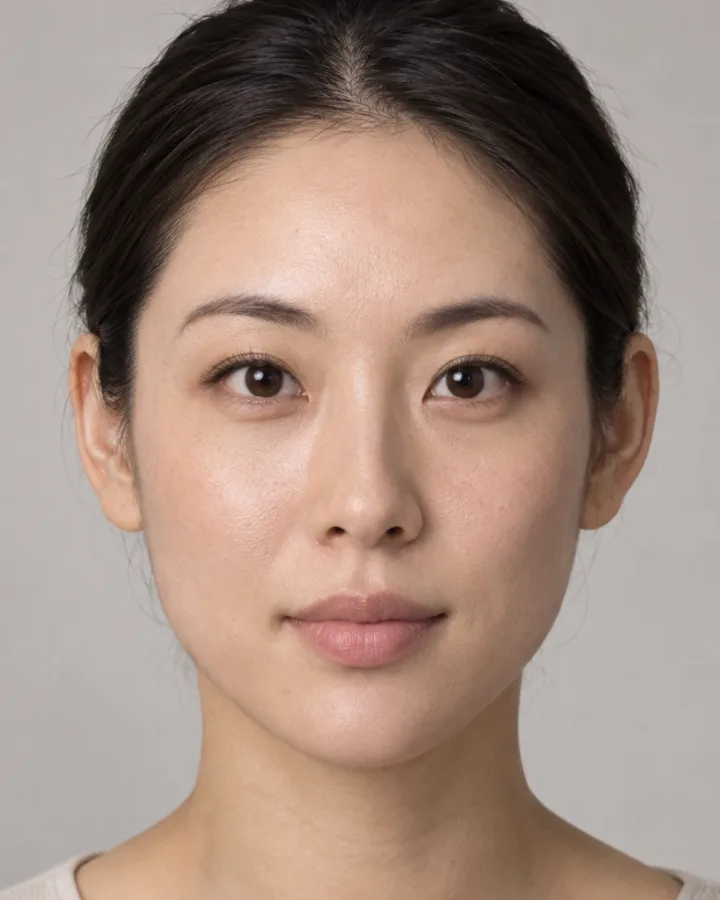
+8.5°
Positive tilt
R +7.8° · L +9.1°
Gap 1.2° · floor 1.5° · gap is inside the floor
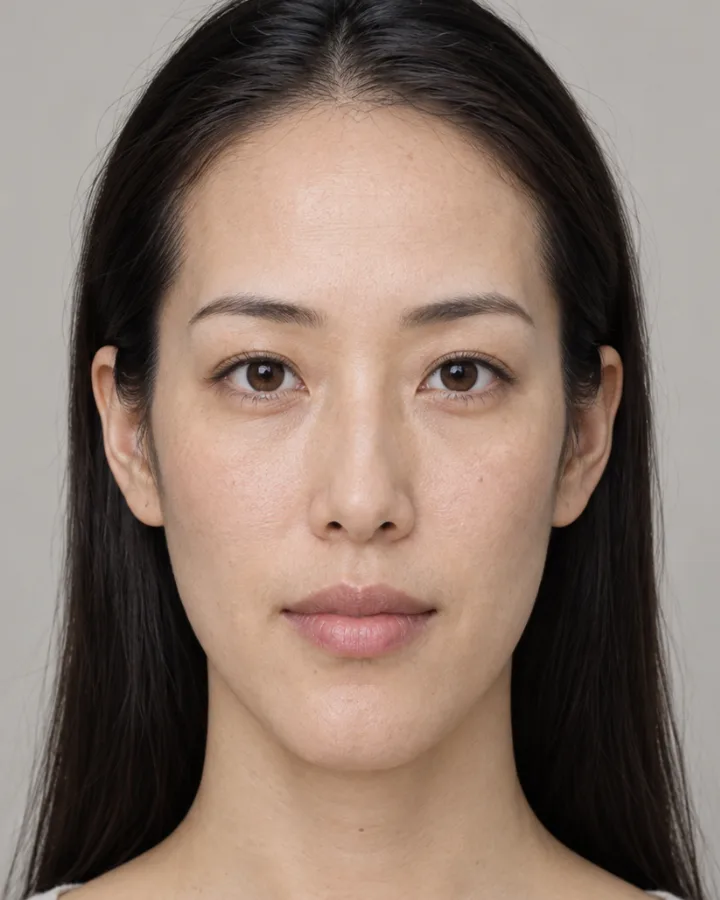
+7.2°
Positive tilt
R +6.7° · L +7.7°
Gap 1.0° · floor 1.8° · gap is inside the floor
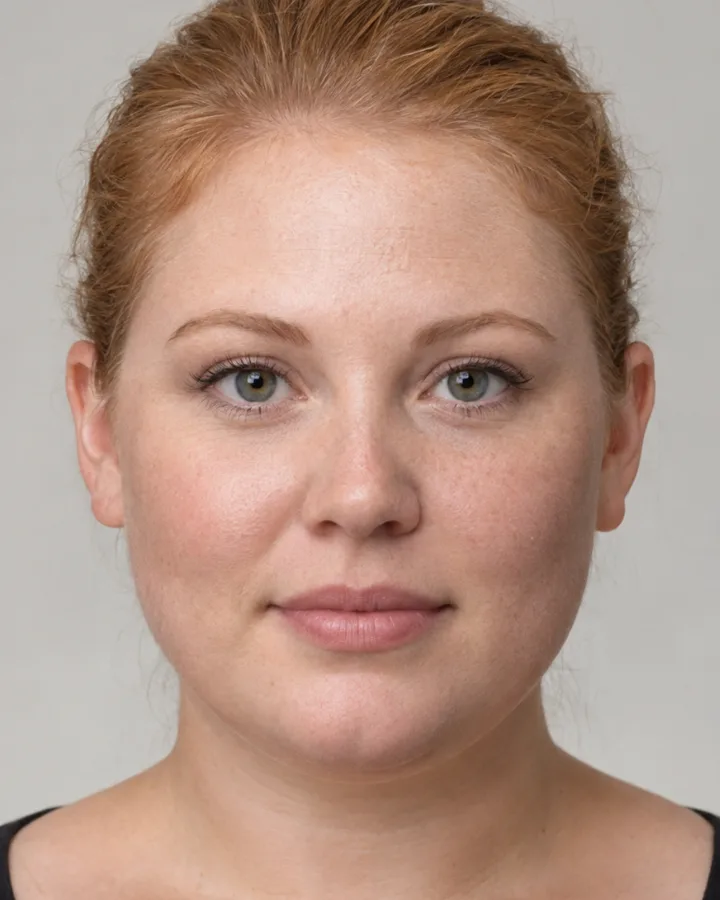
+7.2°
Positive tilt
R +6.7° · L +7.8°
Gap 1.1° · floor 1.4° · gap is inside the floor
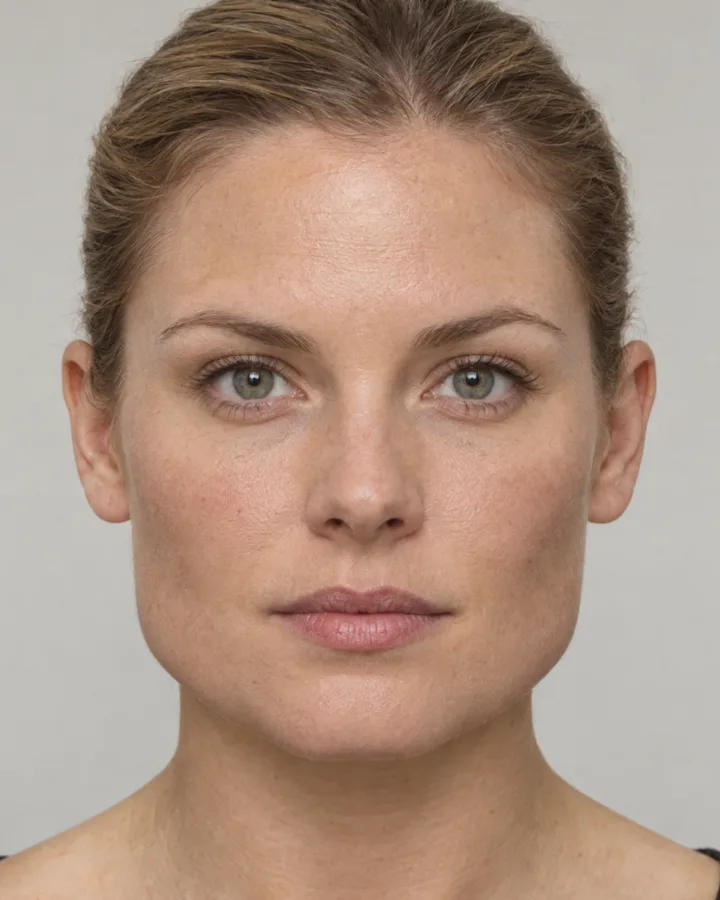
+7.0°
Positive tilt
R +6.6° · L +7.3°
Gap 0.8° · floor 1.5° · gap is inside the floor
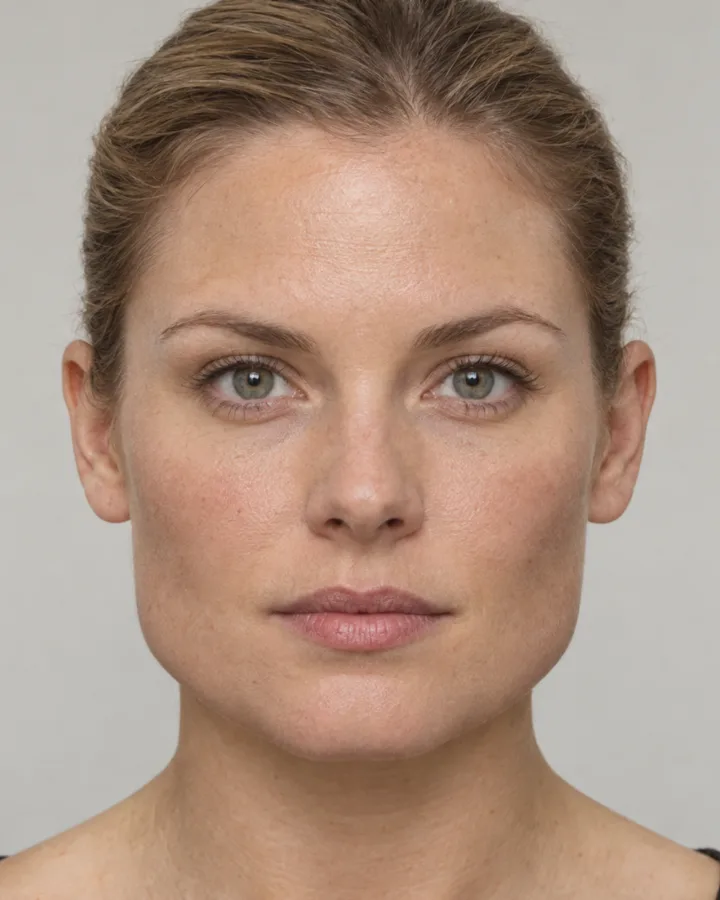
+7.0°
Positive tilt
R +6.6° · L +7.3°
Gap 0.8° · floor 1.5° · gap is inside the floor
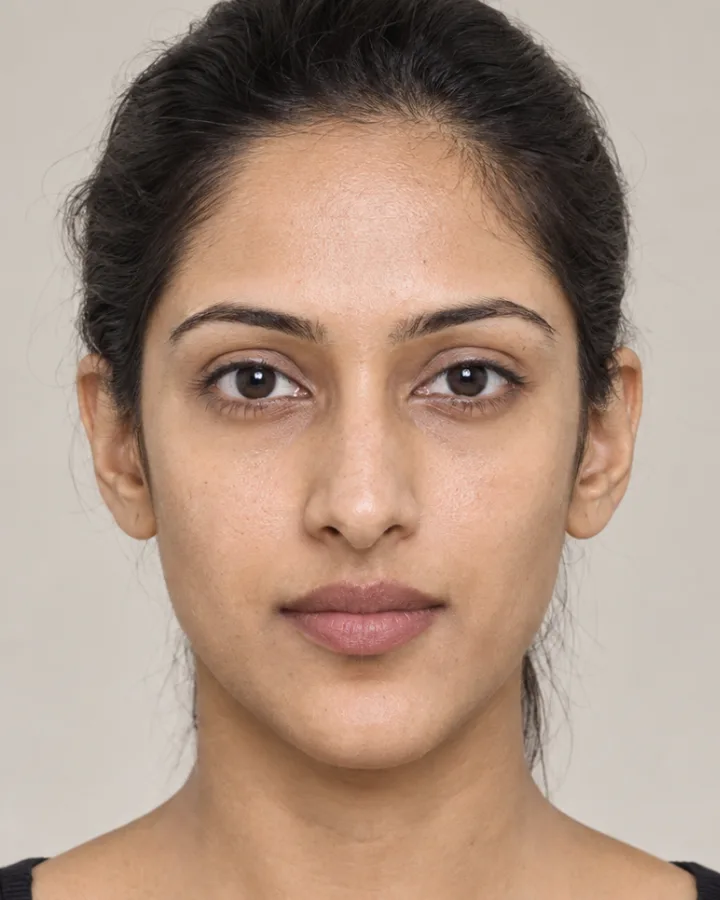
+6.4°
Positive tilt
R +6.3° · L +6.4°
Gap 0.2° · floor 1.3° · gap is inside the floor

+3.7°
Neutral to mild
R +3.2° · L +4.2°
Gap 1.1° · floor 1.3° · gap is inside the floor

+3.4°
Neutral to mild
R +3.7° · L +3.1°
Gap 0.6° · floor 1.5° · gap is inside the floor

+3.3°
Neutral to mild
R +2.8° · L +3.8°
Gap 1.0° · floor 1.4° · gap is inside the floor
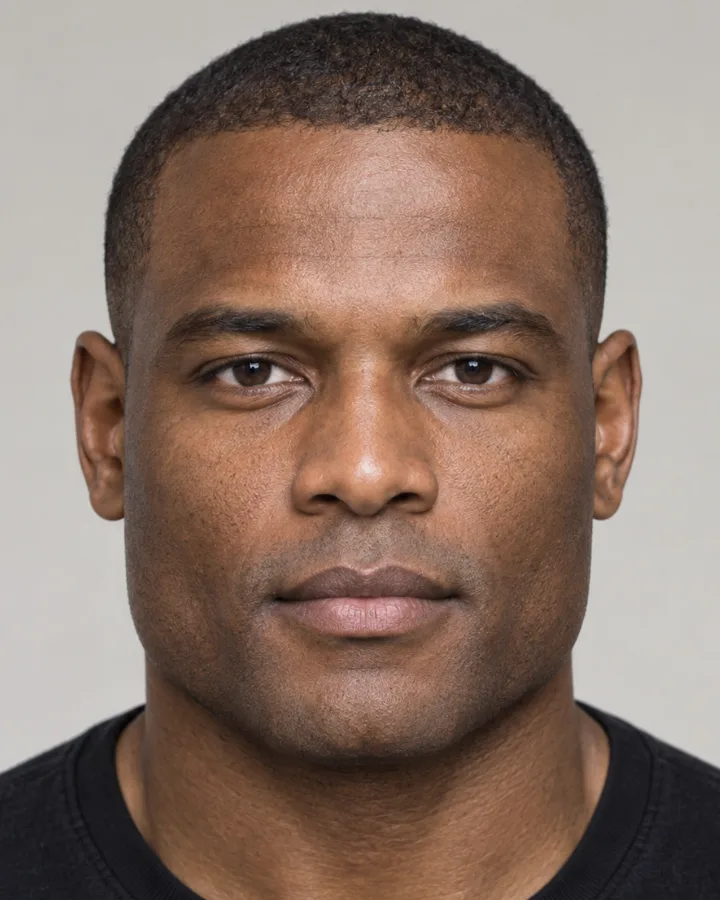
+2.6°
Neutral to mild
R +2.4° · L +2.7°
Gap 0.3° · floor 1.6° · gap is inside the floor

+2.5°
Neutral to mild
R +2.1° · L +2.8°
Gap 0.7° · floor 1.7° · gap is inside the floor
If you compare canthal tilt numbers across sources you will eventually hit two that cannot both be right. This is why, and no consumer page we found flags it.
Convention A
roughly 0 to 10 degrees
The angle between the line joining your two eye corners and true horizontal. Used by consumer pages and most surgical papers. This is what the tool above measures.
Convention B
roughly 165 to 178 degrees
A three-point angle measured at the medial canthus, from one outer corner through the inner corners. Used by the 3D photogrammetry groups whose papers supply most of the recent normative data.
The two are roughly complementary: subtract a Convention A value from 180 and you land near a Convention B one. So a page that prints "170.8 degrees" beside "8.45 degrees" as though they were rival estimates of the same quantity is comparing a number to its own complement. They can describe the identical eye.
One honesty note about that arithmetic: the 180-minus relationship is our own, stated here so you can check it. No paper we read sets the two conventions against each other or publishes a conversion. Treat it as a way to notice you are reading two different scales, not as a formula to convert somebody's published mean.
The canthal tilt pages that rank you against an ideal band mostly cite two sources. We went and read both.
One prominent facial-analysis site attributes that range to Kuraguchi et al. 2015. That paper is a perception experiment on baby schema and attractiveness: 17 Japanese women's photographs, rated by 69 students in Kyoto, measuring forehead-to-face ratio, eye-to-face ratio and eye roundness. The words "canthal", "canthus" and "tilt" do not appear anywhere in it, and it reports no angle in degrees at all. The companion citation for men, a 1990 attractiveness study, describes only distance ratios in every account of its variables we could reach.
An anthropometric degree range is being sourced to a perception study that contains no anthropometric degrees.
Attributed everywhere to a 1994 anthropometry reference. That book is print-only and not indexed full text anywhere we could reach, so we cannot confirm or deny it directly and we are not going to repeat it as though we had. What we can say is that no peer-reviewed paper we found reproduces those three numbers, and that the page publishing them also prints four overlapping "ideal" bands of its own.
The decline figure is checkable, though, and it does not survive. Half a degree per decade from thirty to eighty is two and a half degrees of drift, which would be plain in any age-stratified dataset. The best one available, 320 people aged 10 to 89 with twenty men and twenty women in every decade, measured the height of the lateral canthus and found it "was also not affected by age" with "no difference between the sexes." The same authors address the claim head-on: some have postulated that aging lowers the lateral canthus, but this "has, however, not been substantiated by any measurements."
What does change with age in that study is everything around the canthus: the eye opening lengthens about 3 mm between 12 and 25, then shortens about 2.5 mm between 35 and 85, the lower lid descends around a millimetre, and the lateral canthus moves inward rather than downward. The tilt looks like it falls. The corner has not moved.
| Source | Who was measured | Value | Convention |
|---|---|---|---|
| Lee 2020, N=76 | Korean patients 13-38, surgical assessment | 8.45 / 8.42 degrees | A |
| Li 2023, N=145 | Caucasian eyelid-surgery patients 35-91 | 170.8 degrees | B |
| Gao 2025, N=147 | Healthy Chinese and Caucasian, 18-30 | 164.3 to 178.4 degrees | B |
| Attributed to a 1994 book | unverifiable | 2 to 10 degrees | A, presumed |
No two of these are comparable. Population, age range, health status, landmark definition and angle convention all differ, and three of the four are clinical samples: people who turned up at a hospital about their eyes or their jaw. None is a general population reference, so none of them is your norm.
The healthy young sample is the most interesting because of how wide it is. Among Caucasian men aged 18 to 30 the standard deviation was 14.7 degrees, which is larger than the entire "ideal band" any consumer page prints. A sex difference appeared in one population and not in the other, in the same lab, on the same instrument, with the same definition. That is variation. It is not a ladder, and nothing on this page ranks it.
Two papers from the same group even disagree with each other about whether Caucasian men and women differ. Same instrument, same landmarks, different cohorts, opposite answers. When the literature contradicts itself this cleanly, a single ideal band printed to one decimal place is not a summary of it.
Here is the detail that changed how we think about our own measurement. Every published canthal tilt figure we found came from conditions nothing like a phone camera. The 3D photogrammetry studies used a fixed clinical rig, calibrated daily, with a single trained operator taking every capture. The 320-person age study used projected slides with constructed reference lines.
Those are the conditions under which researchers are willing to report an angle to one decimal place. A selfie has none of them: no calibration, no fixed distance, no controlled lens, no trained operator, and a head pose that changes the measured angle while nothing anatomical changes at all. That gap is precisely why this page measures your photo five times, derives a floor in degrees from how far the points move between passes, and refuses to print anything below it.
It is worth noticing what two competitor pages recommend instead. Both suggest changing your photo angle if you do not like your result. That works, in the sense that it changes the number. It changes the measurement, not the eye, which is the same fact our floor exists to make visible.
Strictly descriptive, and the honest summary is a list of negatives. Searching the biomedical literature for canthal tilt alongside exercise, massage, mewing, taping or gua sha returns eleven papers, all surgical or periorbital rejuvenation, and zero interventional studies. The broadest systematic review of conservative facial techniques, twelve studies and 321 women, concludes that evidence "remains insufficient to establish the efficacy of these mechanical facial rejuvenation techniques with confidence" -- and it did not measure canthal tilt either. No filler study measures it.
The larger surprise is on the surgical side. No study we found reports a canthal tilt in degrees before and after any operation. Surgical outcomes are published in millimetres of lid position or as categorical success rates. So every "canthoplasty raises your tilt by X degrees" figure in consumer content has no primary source behind it.
The single measured exception is small: barbed threads in 22 Asian women moved the angle from 2.1 to 4.3 degrees at six months, regressing to 3.6 by twelve, in an uncontrolled retrospective series with bruising in 36% and swelling in 23%. That is one clinical procedure, not a technique anyone applies at home.
Two corrections to what the rest of the internet says here. First, canthopexy and canthoplasty are not interchangeable: the distinction is whether the lateral canthal tendon is actually divided, and pages claiming "the only structural fix is canthoplasty" skip that entirely. Second, the common line that tilt is "set by the bone" does not match what surgeons operate on, which is the lateral canthal tendon and its attachment to the bone rather than the bone itself. Any of this is a conversation for an oculoplastic surgeon, and the findings that actually matter clinically are functional ones -- lid laxity, malposition, scleral show, exposure -- not an angle measured off a photograph.
No, and this one is easy to check. Searching Europe PMC, which indexes PubMed and MEDLINE plus preprints and agency reports, returns zero records for "hunter eyes". The same search returns 82 records for "canthal tilt". It is not an anatomical term; it is forum vocabulary from the PSL and looksmaxxing communities of the 2010s, which reached a wider audience through TikTok. Those forums are defunct, so a dated first use is no longer recoverable, and we are not going to invent one.
There is an internal contradiction in the folk definition worth pointing out. The composite bundles positive canthal tilt with hooded, low upper-lid exposure. But in the measured literature, upper-lid hooding is dermatochalasis: it was the presenting complaint of all 145 patients in one of the datasets quoted above, which is to say the thing they were at the hospital to have removed. The desirable label and the surgical indication are the same feature.