Face measurements: measure your face in four steps
Four straight-line readings, one ruler. Type them in and you get three ratios, the shape they sit nearest to, and a check on how much a slipped reading would change that.
Enter your four face measurements
Hairline to the tip of the chin, in a straight line down the middle.
Across the forehead at its widest, from one temple to the other.
Across the cheekbones at their widest point, arch to arch.
Straight across between the two jaw corners, below the ears.
Your result
Four numbers, then three ratios
0 of 4 readings usable
Fill in all four readings, or load a measured face below the boxes. The ratios, the widest part, the nearest shapes and a check on how much a slipped reading would change the answer appear here as you type.
Next: see all six shapes side by side on the face shape chart, or skip the ruler and let the face shape detector read your ratios from a photo.
The short answer
- Four readings. Face length, forehead width, cheekbone width and jaw width, all in straight lines and one unit.
- Divide by the cheekbones. Length, forehead and jaw each become a ratio against cheekbone width, so a bigger head does not change the answer.
- Two pencils beat a tape. A tape follows the skin around the curve. Pencils at the edges give the straight-line gap a caliper would.
- A few millimetres can move the call. Slip every reading by 3 mm and a face near the line between two shapes changes its nearest shape. The result panel shows how often.
How to measure your face, one line at a time
Stand square to a mirror with your hair back and your face relaxed. Hold the head level, with the lower edge of the eye socket and the top of the ear hole on one horizontal. Take each reading twice and write down the middle value if they differ.
- 1
Face length
Set one pencil level with the hairline in the middle of the forehead and one at the lowest point of the chin. Measure the gap.
The usual slip: Reading the brow as the top, which removes the forehead and makes every ratio read short.
Anthropometry name: trichion to gnathion, or total face height.
- 2
Forehead width
Put the pencils on the two temples, where the forehead turns back toward the ears, at the level of the brow tails.
The usual slip: Measuring along the hairline. A hairline is a haircut, a temple is bone.
Taken at the temples, never along the hairline.
- 3
Cheekbone width
Feel for the arch in front of each ear and put the pencils on the outer edges of the two arches at their widest.
The usual slip: Pressing into the cheek flesh, which reads narrow, or letting a tape curve over the face, which reads wide.
Anthropometry name: bizygomatic breadth. Every ratio on this page divides by it.
- 4
Jaw width
Find the corner of the jaw below each ear, where the jawline turns up toward the ear, and measure straight across.
The usual slip: Measuring across the chin. The corners are well back of it and sit near the earlobes.
Anthropometry name: bigonial breadth.
No pencils? Use a bank card as the ruler
A bank card is 85.60 mm wide and 53.98 mm tall (ISO/IEC 7810 ID-1). Have someone take a front photo from a metre or more away, with the card held flat against your cheek. Zoom in, count the pixels across the card, then divide each pixel distance on your face by that count and multiply by 85.6. Lean forward or tilt and you lose the plane the card is in, so keep the face square to the lens.
Measured faces, with their numbers
These portraits are AI generated, and each was run through the homepage detector. The three numbers are measured ratios, and the name on each card is the detector's, which also reads jaw angle. The ruler tool leaves jaw angle out, so a loaded card can come back with a different nearest shape. The centimetres are only a scale: a photo has none, so each face is laid on a 14 cm cheekbone line. Load any of them into the boxes above and change a reading to see what moves.
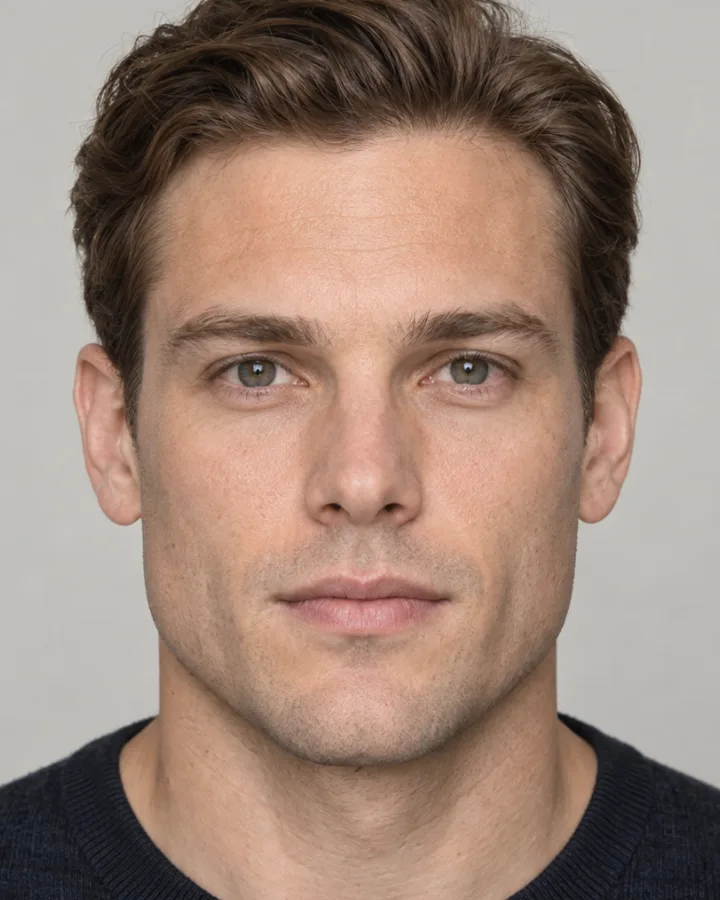
Oval
1.37 / 0.86 / 0.82
On a 14.0 cm cheekbone line: 19.1 cm long, forehead 12.0 cm, jaw 11.5 cm.
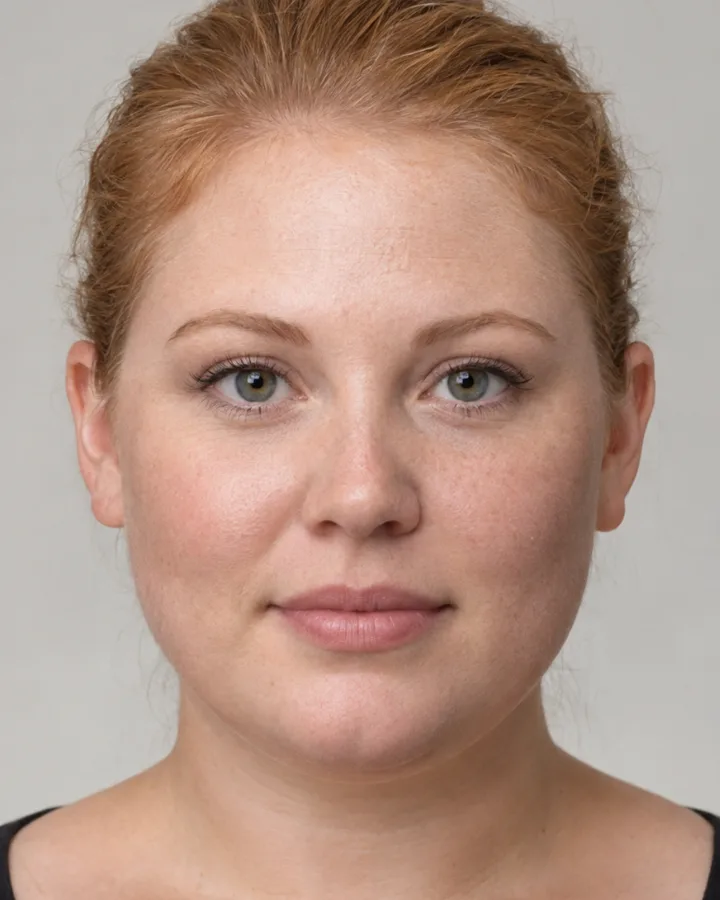
Round
1.28 / 0.85 / 0.78
On a 14.0 cm cheekbone line: 17.9 cm long, forehead 11.9 cm, jaw 11.0 cm.
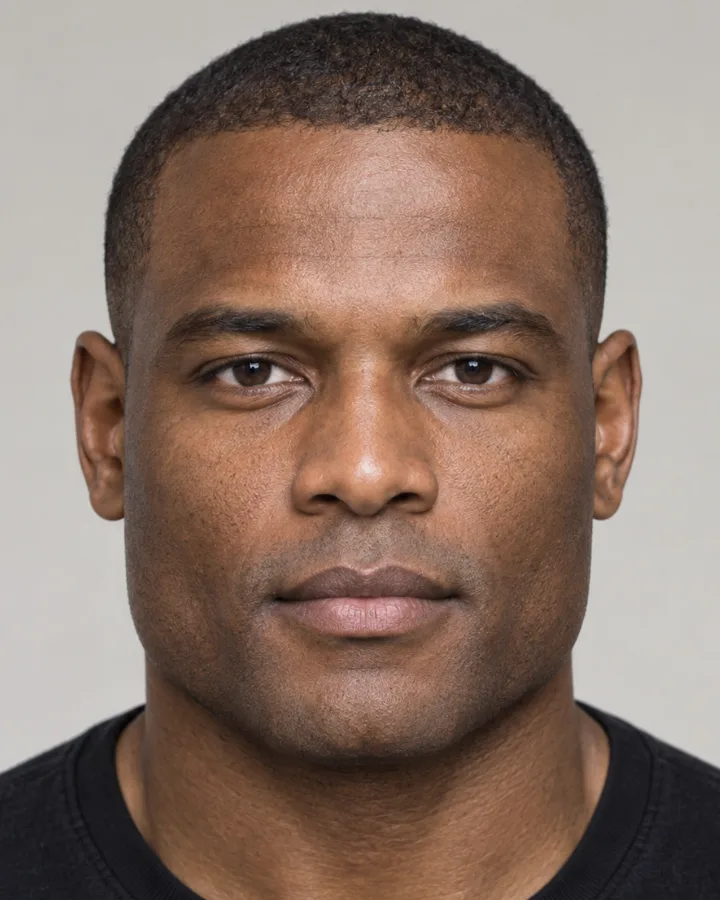
Square
1.31 / 0.87 / 0.85
On a 14.0 cm cheekbone line: 18.4 cm long, forehead 12.2 cm, jaw 12.0 cm.
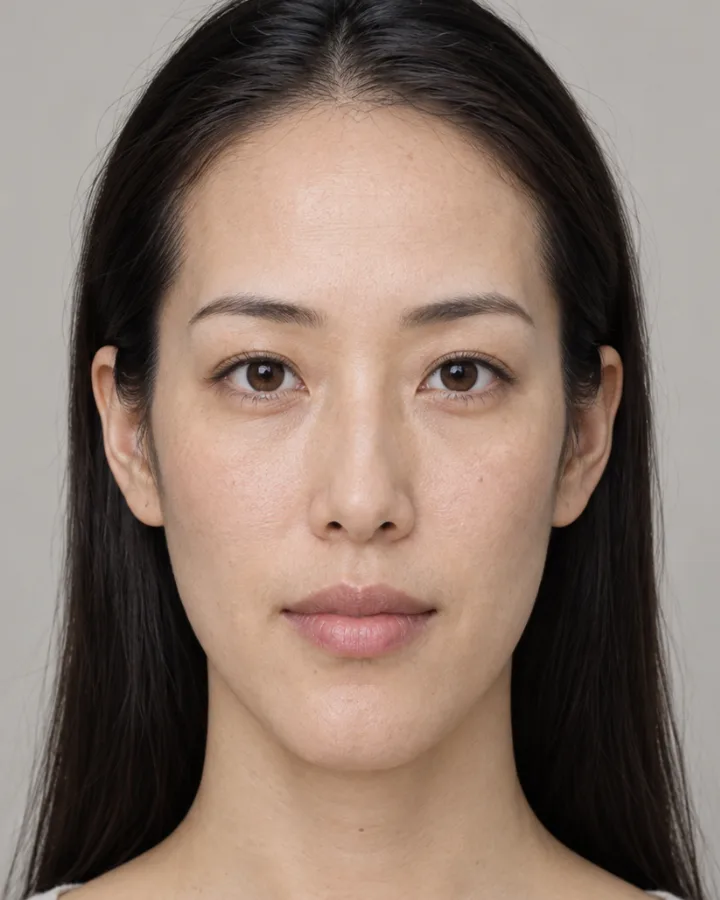
Oblong
1.50 / 0.85 / 0.77
On a 14.0 cm cheekbone line: 21.0 cm long, forehead 11.9 cm, jaw 10.7 cm.
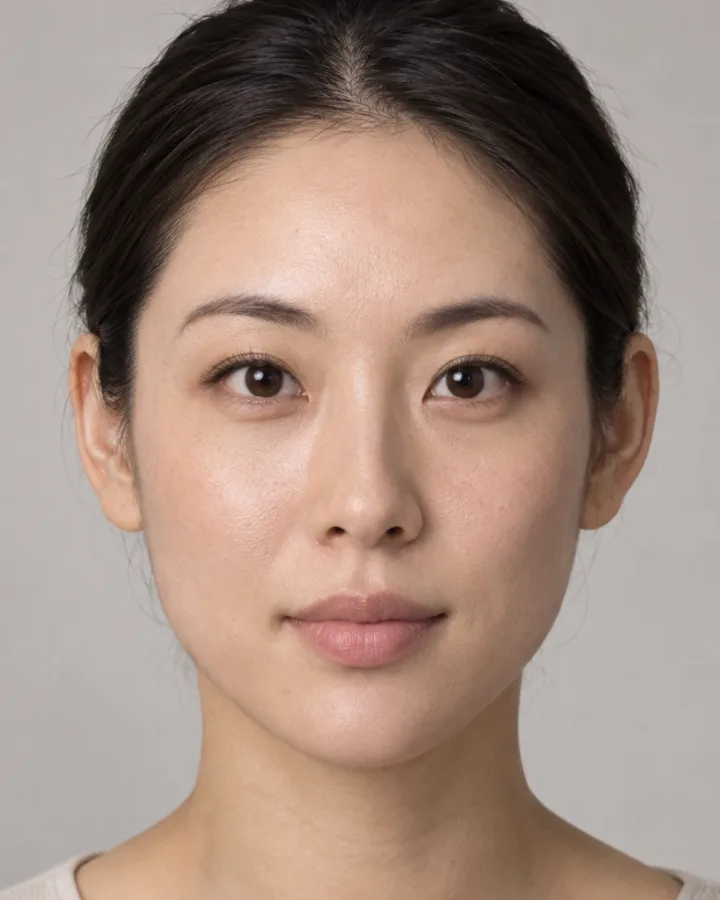
Heart
1.37 / 0.85 / 0.77
On a 14.0 cm cheekbone line: 19.1 cm long, forehead 11.9 cm, jaw 10.7 cm.
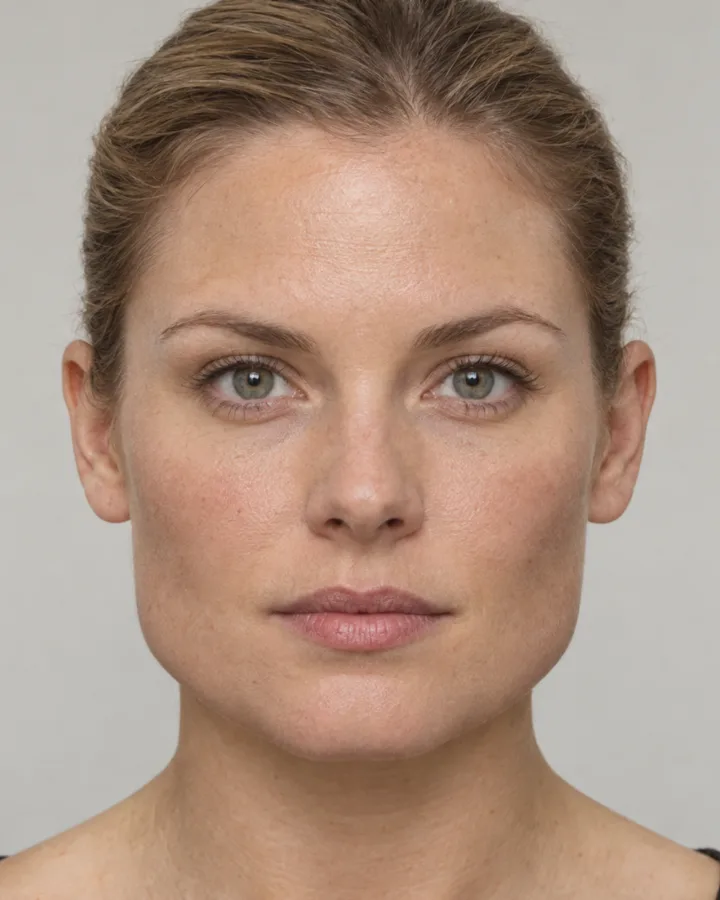
Square or oval
1.29 / 0.85 / 0.82
On a 14.0 cm cheekbone line: 18.1 cm long, forehead 12.0 cm, jaw 11.5 cm.
Which measuring tool to use
The readings only mean something if they are straight lines. This is how each way of measuring behaves.
| Method | Best for | Not ideal for | Straight line? |
|---|---|---|---|
| Two pencils and a ruler | A straight-line gap you can read off a flat ruler, like a caliper | Doing it alone in a hurry: the pencils move when you let go | Yes |
| Sewing tape | Length, and checking a number you already have | Cheekbone and jaw width: it follows the curve and reads long | No, it follows the skin |
| Ruler held up to a mirror | Quick checks of length | Widths: you read it at an angle and the mirror adds a second gap | Only if you look square on |
| Photo with a bank card | When someone else holds the phone and you want a record | A head that is turned or tilted, or a phone held close | Yes, if the face is square to the lens |
| The homepage detector | Ratios without a ruler, from 478 mesh points on your device | Centimetres: it reports ratios only | Yes, and it rejects a head turned past 15 degrees |
The three ratios, and what each can and cannot tell you
Every ratio divides by cheekbone width, so a larger or smaller head gives the same numbers. A value under 1.00 for forehead or jaw means narrower than the cheekbones. The shape names themselves are laid out on the face shape chart, and the classical beauty rules are tested against measurements on face proportions.
| Ratio | Worked out as | What it tells you | What it cannot tell you |
|---|---|---|---|
| Length against cheekbones | face length / cheekbone width | How long the face is for its width. Higher is a longer face. | Which part is widest. A long face can be wide at the forehead or the jaw. |
| Forehead against cheekbones | forehead width / cheekbone width | Whether the forehead is narrower than the cheekbones (under 1.00) or as wide or wider (1.00 or more). | How the forehead is shaped. A flat and a rounded forehead can share a width. |
| Jaw against cheekbones | jaw width / cheekbone width | How much the face narrows from cheekbones to jaw corners. Lower narrows more. | The jaw corner itself. Two jaws of equal width can be soft or angular. |
Ruler widths and photo widths are not the same line. The detector reads forehead and jaw between two fixed mesh points, and it cannot see the hairline, so it estimates face length as the mesh length times a fixed 1.12 that has not been checked against ruler-measured faces. Expect your ruler ratios to differ from the detector's by a few hundredths, and trust neither to the second decimal.
How much a few millimetres matter
The result panel adds 3 mm to or takes 3 mm from each of the four readings, in every one of the 16 combinations, and counts how many still land on the same nearest shape. 3 mm is our choice, not a measured error rate. Here it is for the three example faces above, each on a 14 cm cheekbone line.
| Example face | Same nearest shape | Moves to |
|---|---|---|
| A long face | 14 of 16 | diamond, heart |
| A short, wide face | 6 of 16 | heart, oval, square, diamond |
| A face between two shapes | 6 of 16 | square, oval, heart |
A clearly long face keeps its answer through almost every slip. A face that sits between two shapes does not, and that is a fact about the face, not a fault in the tool. If your result moves, measure each line twice, and read the answer as a pair of shapes.
Questions people ask about measuring their face
How do you measure your face?
+
Take four straight-line readings and write them down in one unit. Length runs from the hairline to the tip of the chin. Forehead width is the widest span between the temples. Cheekbone width is the widest span across the cheekbones, arch to arch. Jaw width is the span between the two jaw corners below the ears. A soft tape follows the skin around the curve and reads long, so hold two pencils at the edges instead and measure the gap between them on a flat ruler. Do each reading twice and keep the middle value if they differ.
How do you measure face length?
+
From where the forehead skin meets the hair, in the middle, to the lowest point of the chin, in a straight line. The soft part is the hairline: if it has receded or the hair grows low, pull the hair back and pick the point where the forehead stops being skin, and use the same point every time. Keep your head level, with the lower edge of the eye socket and the top of the ear hole on the same horizontal, or the chin will read short. Anthropometry papers call this trichion to gnathion, or total face height.
How do you measure cheekbone width?
+
Find the cheekbone arch with a fingertip, the ridge in front of the ear that runs out toward the eye, and measure straight across from the outer edge of one arch to the other at the widest point. Anthropometry calls it bizygomatic breadth. Two slips are common: measuring across the soft cheeks at the smile line, which reads narrow, and draping a tape over the face, which reads wide because it follows the curve. Hold the pencils on the bone, not the flesh.
What do face measurements say about face shape?
+
Three ratios do most of the work: length against cheekbone width, forehead against cheekbone width, and jaw against cheekbone width. A face clearly longer than it is wide points to oval or oblong, and a short face to round or square. Whichever of forehead, cheekbones and jaw is widest separates heart and diamond from the rest. This page uses no fixed numeric cut-offs between these labels. It ranks your ratios against measured faces and shows how close the call is, rather than printing a verdict. A jaw corner cannot be read from widths alone, and it is what separates round from square when their proportions match.
What are average face measurements?
+
There is no single average to quote. Face length and widths differ by sex, age and population, and a table that fits the wrong group misleads more than it helps, so none is printed here. The large public reference is the ANSUR II survey of US Army personnel, which lists bizygomatic breadth, bigonial breadth and menton-sellion length among its raw measurements, and the 1994 Farkas anthropometry handbook is the standard clinical reference. Ratios travel better than centimetres: a face that is 14 cm wide and one that is 12.5 cm wide can have the same three ratios.
Can I measure my face from a photo?
+
Yes, for ratios. A photo has no scale, so centimetres need a reference in the same plane, and a bank card is 85.6 mm wide. Keep the camera at eye level and a metre or more away, hold the card against your cheek, and divide each pixel distance by the card's pixel width times 85.6. Any head turn or tilt changes the readings, which is why the face shape detector on the homepage measures from 478 mesh points on your device and reports ratios only.
Sources: ISO/IEC 7810 ID-1 card size, 85.60 by 53.98 mm · ANSUR II, US Army Anthropometric Survey 2012 (public database) · Farkas LG, Anthropometry of the Head and Face, 2nd ed., 1994 · soft classification and ranges are this site's own measured set of AI-generated portraits, not a population sample.