MeasureFace

Diamond face shape, and the five it gets confused with

A diamond face shape has cheekbones as its widest point, with a narrower forehead and a narrower jaw tapering to a pointed chin. The narrow forehead is the whole definition, and it is also the reason diamond is the hardest of the six face shape types to identify from a photograph. This guide describes all six, shows a measured face for each, and is honest about which one our own tool keeps getting wrong.

The four lengths that decide a face shape

What a face shape is made of

  • Forehead54 to 284
  • Cheekbones234 to 454
  • Jaw172 to 397
  • Length10 to 152

Three widths and one length. Every shape name on this page is a statement about how those four compare, plus the angle at the corner of the jaw.

Drawn from a face this tool measured, with the MediaPipe landmark indices the code reads. Note where the forehead line sits: at the temples, not the hairline. The mesh has no hairline point, which matters more for the diamond face shape than for any other.

The six face shape types, each with a measured face

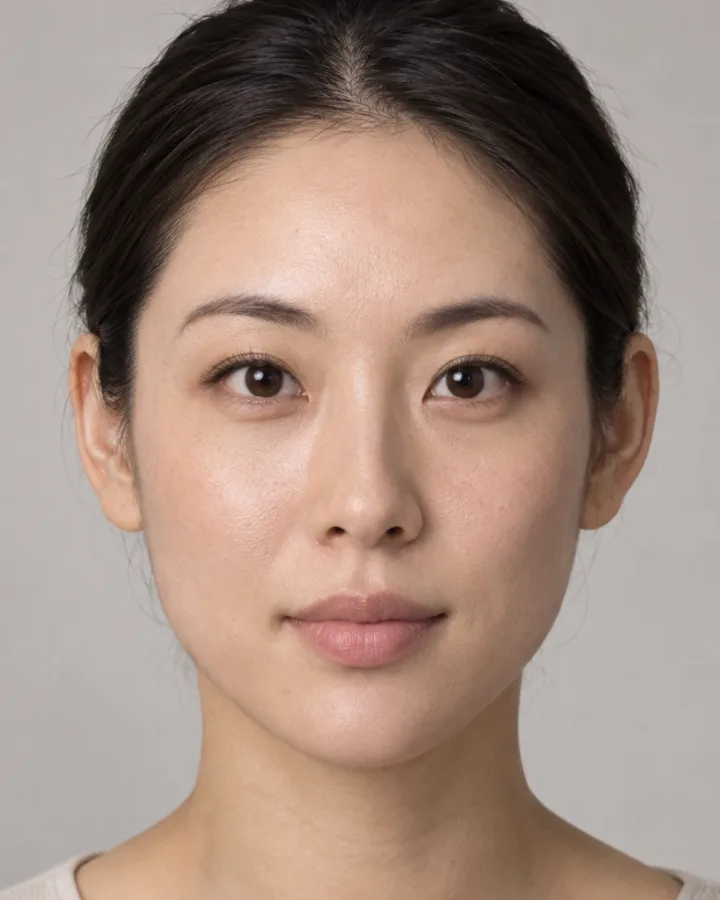
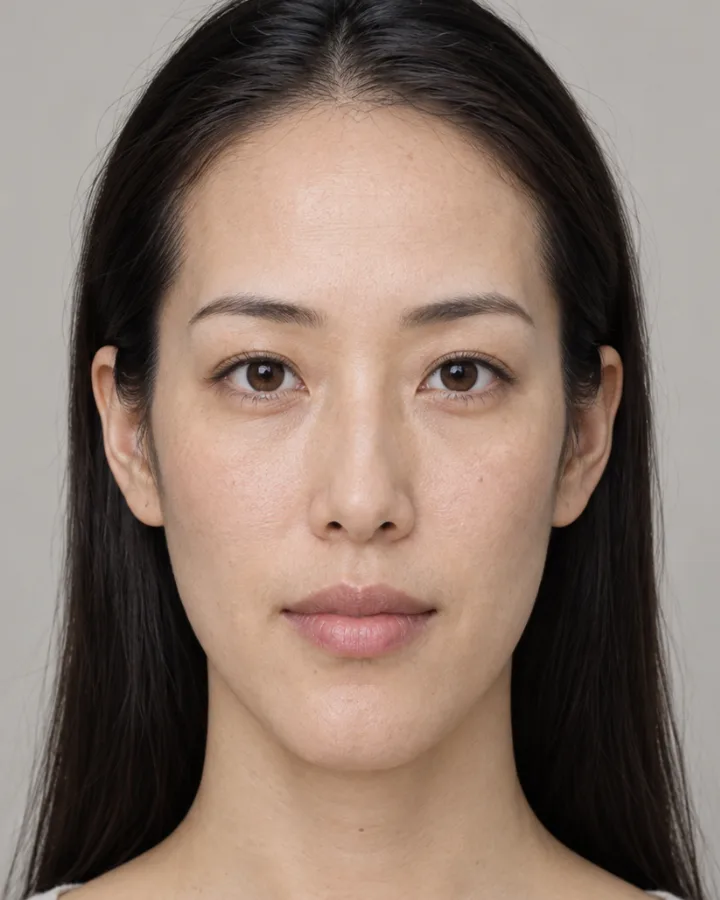
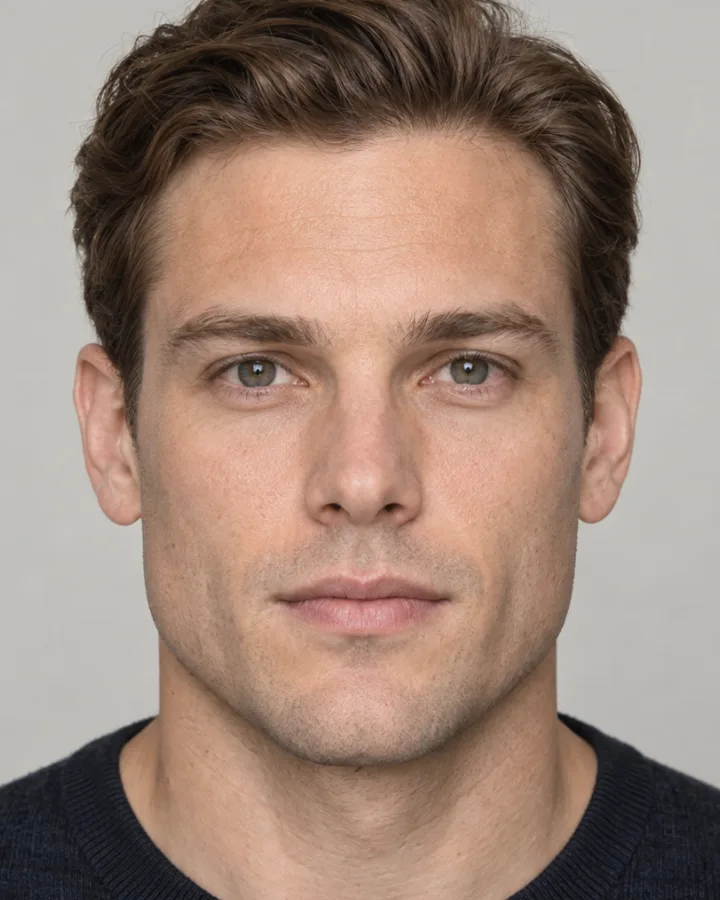
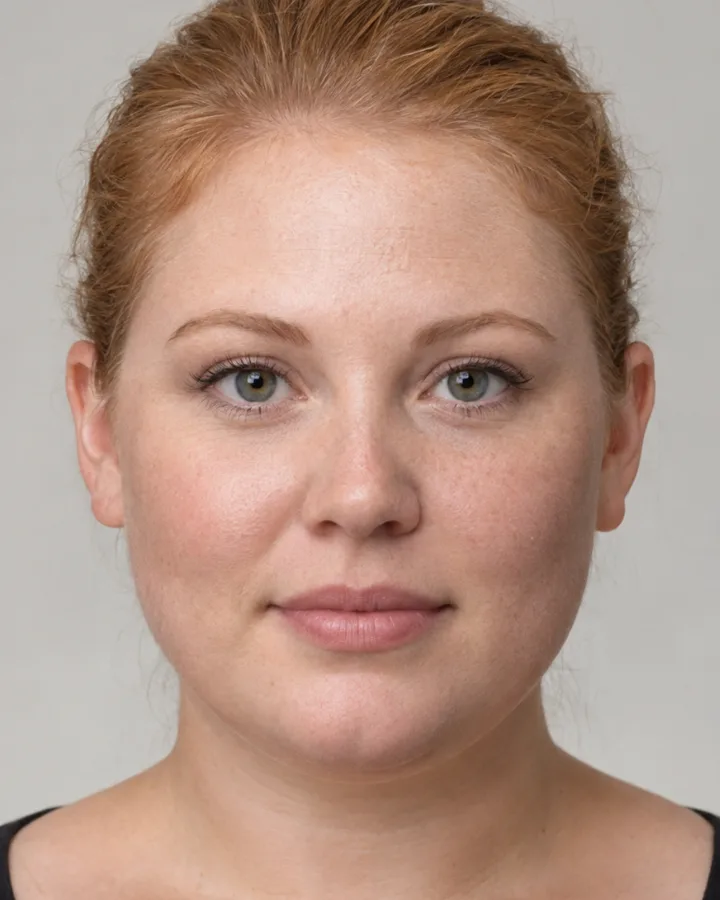
Every card below carries a real portrait this tool measured and the numbers it returned, rather than an illustration drawn to fit the label. Length is the face length divided by cheekbone width. Forehead and jaw are each given as a share of cheekbone width, so a number below 1.00 means narrower than the cheekbones.

  • no measured example

    Diamond

    We have no portrait that measures as diamond. That is not an oversight. See below.

    Cheekbones are the widest part by a clear margin, with both the forehead and the jaw noticeably narrower, and the chin coming to a point.

    How to tell: The forehead is narrow. That is what separates diamond from every other shape, and it is also the hardest thing to judge.

    Confused with: Heart, which also narrows to a pointed chin but keeps a wide forehead.

  • AI generated face measured as heart

    Heart

    Length
    1.37
    Forehead
    0.85
    Jaw
    0.77
    Jaw angle
    135°

    Widest across the forehead, narrowing through the cheeks to a small and often pointed chin.

    How to tell: Forehead wider than the jaw, usually by a lot. Sometimes a widow's peak, though that is hair rather than bone.

    Confused with: Diamond. The chin looks the same; the forehead does not.

  • AI generated face measured as oblong

    Oblong

    Length
    1.50
    Forehead
    0.85
    Jaw
    0.77
    Jaw angle
    139°

    Noticeably longer than it is wide, with forehead, cheekbones and jaw close to the same width down the whole face.

    How to tell: The sides run almost parallel. Length is doing the work rather than any one width.

    Confused with: Oval, which is also long but curves in at the jaw instead of running straight.

  • AI generated face measured as oval

    Oval

    Length
    1.37
    Forehead
    0.86
    Jaw
    0.82
    Jaw angle
    131°

    Longer than wide, widest at the cheekbones, tapering gently to a rounded chin with no hard corners anywhere.

    How to tell: Everything is in the middle of its range. Oval is the shape defined by not being any of the others.

    Confused with: Oblong when the face is long, round when it is not.

  • AI generated face measured as round

    Round

    Length
    1.28
    Forehead
    0.85
    Jaw
    0.78
    Jaw angle
    131°

    Length and width are close to equal, the cheeks are the fullest part, and the jaw curves with no visible corner.

    How to tell: No corner at the jaw. If you can find the angle where the jaw turns, it is probably square.

    Confused with: Square, which has the same proportions but a corner.

  • AI generated face measured as square

    Square

    Length
    1.29
    Forehead
    0.85
    Jaw
    0.82
    Jaw angle
    127°

    Forehead, cheekbones and jaw are close to the same width, and the jaw has a defined corner below the ear.

    How to tell: The corner. Square and round differ by jaw angle, not by proportion.

    Confused with: Round. The two are the same rectangle with different corners.

The diamond face shape, and the one our own tool cannot reliably find

The diamond card above has no measured face in it, and that is worth explaining rather than hiding, because it is the most useful thing we know about this shape.

We ran the classifier over 307 measured faces. Twenty-one of them came back diamond, which sounds fine until you look at where they came from: all 21 results trace to just three faces, and all three have hair falling over the temples. We then generated 21 portraits with explicit diamond geometry, narrow forehead, wide cheekbones, pointed chin, with the hair pulled fully back. Every one of them measured as heart or oblong. Not one measured diamond.

The cause is in the diagram at the top of this page. The face mesh has no hairline landmark, so the forehead width is measured at the temples, and the top of the head is estimated rather than seen. When hair covers the temples the measured forehead narrows, and a narrow forehead is exactly the signature of a diamond face. So the tool finds diamond when hair hides the forehead, and misses it when the forehead is visible. That is close to the opposite of what it should do.

What that means for you: if you think you have a diamond face shape, our tool is the wrong instrument to confirm it. Measure the distance across your temples and across your cheekbones with a tape instead. If the temples are clearly narrower and your chin comes to a point, diamond is a reasonable description regardless of what any photo tool returns.

We could have fixed the appearance of this by loosening the thresholds until some faces came back diamond. That would have produced a label without producing a measurement, and it would have hidden a real limitation behind a plausible-looking result. The classifier stays as it is, and the page says what it does.

Telling the confusable pairs apart

Three pairs account for almost every disagreement about face shape types. Exactly one of them has a defensible numeric criterion behind it, and it is not the pair people argue about most.

Oblong against oval

Measurable

This is purely a length-to-width question, and physical anthropology has measured exactly that for a century as the morphological facial index: face height over cheekbone width, times 100, with five named bands and published population distributions. It is replicable and caliper-measurable.

What it will not give you is the boundary. The anthropometric scale is five bands on one continuum and no publication maps it onto the styling pair, so inventing a cutoff where oval becomes oblong would be manufacturing a number. Use the index to describe how long a face is, not to adjudicate the label.

Round against square

No published criterion

The difference here is jaw angularity, which the facial index cannot see at all: two faces with an identical index can have a soft jaw or a sharp one. The nearest real measurement is the gonial angle, the angle at the corner of the jaw, which is a genuine anthropometric variable.

But no paper defines where a square face begins in degrees, and using the gonial angle that way would be fabrication. One warning if you are tempted to reason it out yourself: the literature reports that this angle increases with age, so the folk rule that a square jaw means a low angle is not a safe simplification.

Heart against triangle

No measurement basis

There is none, because triangle is not in the research at all. The published machine-vision work on face shape uses five classes, heart, oblong, oval, round and square, and triangle appears in none of them.

Triangle and diamond are both styling-site additions, which is visible in their own numbers: three tool sites report triangle at 0.03 percent, 0.05 percent and 8.6 percent. A category whose reported prevalence varies by a factor of nearly 300 between sources is not a category anyone is measuring.

How common is each face shape type?

There is no peer-reviewed prevalence distribution for these six or seven categories in any human population. Every percentage in circulation comes from a face shape tool counting its own visitors, and the four we checked disagree by up to five times on diamond alone. One calls diamond the rarest shape. Another's own figures make it the second most common.

The reason is the taxonomy itself. It did not come from anatomy, it came from eyewear retail, and the number of categories has never settled: four, five, six, seven or nine depending on the source. Physical anthropology does have a real length-to-width taxonomy with published distributions, and in it the most common category flips between populations and with age, so even there the answer is not a single most common face.

The full version of this, with the four tool sites side by side and three measured population studies, is on the face shape detector homepage.

Face shape type questions

What is a diamond face shape?

+

A diamond face shape is one where the cheekbones are the widest part of the face by a clear margin, while both the forehead and the jaw are narrower, and the chin narrows to a point. The narrow forehead is the defining feature. That is what separates it from a heart shape, which also tapers to a pointed chin but keeps a wide forehead, and it is why diamond is genuinely hard to identify from a photograph: the top of the forehead is the one boundary on the face that hair routinely hides, and the landmark model this site uses has no hairline point at all.

Is the diamond face shape rare?

+

Nobody credibly knows, and the sites claiming to know disagree wildly. Across four face shape tools publishing their own user figures, diamond ranges from about 5 percent to 25 percent, a fivefold spread, and one site calls diamond the rarest shape while another's own numbers put it second most common. None of them cites a study, because there is no peer-reviewed prevalence distribution for this taxonomy in any population. The honest answer is that the question has never been measured properly, and anyone giving you a percentage is quoting their own web traffic.

What is the difference between a diamond and a heart face shape?

+

The forehead, and only the forehead. Both narrow to a pointed chin, both have prominent cheekbones, and in photographs they look similar enough that classifiers confuse them constantly. On a heart shape the forehead is the widest part of the face or close to it. On a diamond the forehead is clearly narrower than the cheekbones. If you are looking at your own face and cannot decide, that is the measurement to take, and take it at the temples rather than at the hairline, because the hairline is a haircut and the temples are bone.

How many face shape types are there?

+

It depends who is selling. The machine vision research that classifies faces uses five: heart, oblong, oval, round and square. Most styling sites use six or seven, adding diamond and triangle. One eyewear retailer's own scheme recognised four traditional shapes and then commissioned work proposing five more, for nine in total. The number is unsettled because the taxonomy did not come from anatomy, it came from selling glasses and haircuts, and each addition serves whoever added it rather than describing a real boundary between faces.

Can a face be between two face shape types?

+

Routinely, and there is a measured figure for how unstable the boundaries are. A university study building a face shape classifier checked celebrities whose shape is published in more than one place and found 62 of 117 names had conflicting classifications across the 21 sites reviewed. That is 53 percent disagreement on the same faces using the same labels. The best published classifier in that work agreed with its own human labellers about 85 percent of the time on five classes, which is the realistic ceiling for this kind of judgement rather than a defect of any one tool.

How do I tell an oblong face shape from an oval one?

+

By the sides rather than the length, because both are long. An oblong face runs close to parallel from forehead to jaw, with the three widths similar all the way down. An oval face is widest at the cheekbones and curves inward above and below them. This is the one confusable pair with a real anthropometric measurement behind it: the morphological facial index, face height over cheekbone width, is a published and replicable scale. What it will not do is tell you where oval stops and oblong starts, because that boundary is a styling convention rather than a line in the data.

Now measure your own

Reading a description and holding your own face up against it is guesswork, and the descriptions above overlap on purpose, because real faces do. The tool measures the four lengths in the diagram plus the jaw angle, in your browser, and shows you how close you sit to every shape rather than picking one and hiding the rest.

One caveat carried down from the section above: if you suspect diamond, take a tape to your temples instead. This measurement is the one the tool is weakest at.

Front-facing photo, even light, hair off the forehead

Your four measurements will appear here, next to the cards above, so you can see which shape they sit closest to.